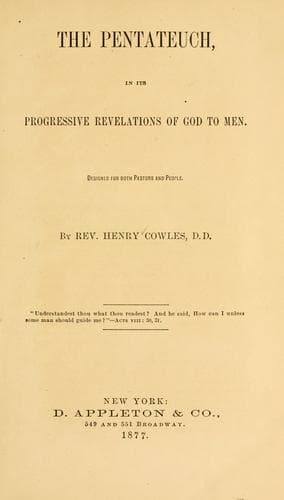
The Pentateuch, in Its Progressive Revelations of God to MenCowles, Henry
Religion
The Pentateuch, in Its Progressive Revelations of God to Men
Cowles, Henry
Bible. Pentateuch -- Criticism, interpretation, etc.
19: 27, 28). The prohibition to eat blood or fat
may have been in part sanitary, but probably was also anti-idolatrous.
The distinction between things clean and unclean helped to make them
a peculiar people, and may have been so intended.
* * * * *
2. _Perjury._ The law of Sinai tacitly indicates that the Lord himself
would take the perjurer in hand, would never hold him guiltless, and
would be responsible for his punishment. The statutes touch only a
single case――“A false witness rising up against any man to testify
against him that which is wrong”――ordaining that the case be brought
before the judges who are to make diligent inquisition. If found
guilty, the evil he thought to bring upon another must be visited upon
himself (Deut. 19: 16–21).――――In general the sanctity of the sacred
oath was shielded by Jehovah himself, searching out and punishing the
guilty. Oaths seem to have been far less frequent than in the modern
administration of law――less frequent, but more sacred, this binding
force being laid on every conscience and left to the awful sanctions
of Jehovah.
* * * * *
3. _Presumptuous sins._ The law against such sins sought to impress
due reverence for God’s authority. A broad distinction was made between
sins of ignorance and sins where knowledge of duty was presupposed and
the offense involved deliberate contempt of God. The external act was
of smallest consequence. The law said, “The soul that doeth _aught_
presumptuously”――no matter what it be. Certain cases are specified
having these common elements――that the law was plain; the duty palpable;
and innocent ignorance not even supposable;――_e. g._ the law of the
Sabbath against all [needless] work (Ex. 31: 14, 15 and 35: 2, 3). The
case (Num. 15: 32–36) of the man who gathered sticks on the Sabbath,
stands in the closest connection with the law against “presumptuous
sins,” showing that the offense was seen in that light. The most
emphatic condemnation of presumptuous sins immediately precedes (vs.
30, 31) in these words: “The soul that doeth aught presumptuously, the
same reproacheth the Lord; and that soul shall be cut off from among
his people” (_i. e._ by capital punishment). “Because he hath despised
the word of the Lord and hath broken his commandment, that soul shall
be utterly cut off; his iniquity shall be upon him.” He must bear it
himself, with no atonement provided for his pardon.――――Other cases
specified are――the eating of unleavened bread during the Passover (Ex.
12: 15); neglect of the Passover when its observance was practicable
(Num. 9: 13); eating certain sacrificial offerings while unclean (Lev.
7: 20, 21); eating fat or blood (Lev. 7: 23–27).
Public-domain text, read in full here on John Shaqi.
Reviews
Reviews
No reviews yet
Be the first to share your thoughts on this work.
Elsewhere in the archive
Join the Discussion
Join the discussion
Sign in to leave a comment or review.
Sign InorCreate an account