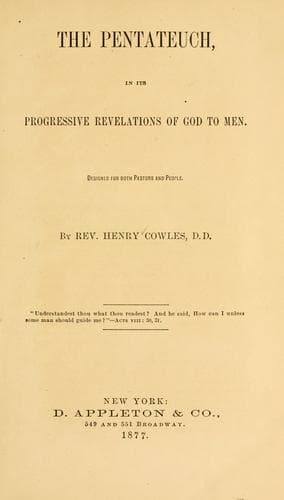
The Pentateuch, in Its Progressive Revelations of God to MenCowles, Henry
Religion
The Pentateuch, in Its Progressive Revelations of God to Men
Cowles, Henry
Bible. Pentateuch -- Criticism, interpretation, etc.
principles to the actual status of the people so as to reach the
highest possible amount of practical efficiency in securing the ends
of justice and of virtue.
* * * * *
The brief analysis and treatment of the _civil code_ here attempted
will follow mainly the same order of subjects which appears in the law
of Sinai; thus:
I. Crimes against God:
1. Idolatry;――2. Perjury;――3. Presumptuous sins;――4. Violations
of the Sabbath;――5. Blasphemy;――6. Magic.
II. Crimes against parents and rulers (Fifth commandment).
III. Crimes against the person and life (Sixth commandment).
IV. Crimes against chastity (Seventh commandment).
V. Crimes against property; laws respecting property (Eighth
commandment).
VI. Crimes against reputation; violations of truth (Ninth commandment).
VII. Hebrew servitude.
VIII. Judicial procedure.
IX. Punishments.
* * * * *
I. Crimes against God:
1. _Idolatry._ The laws against idolatry included both the professed
worship of the true God by means of images, and the worship of
other gods. As the law of Sinai forbade both these practices with
no special discrimination between them, so did the “statutes and
judgments”――the law apparently holding it of small account to attempt
any discrimination. In the case of the golden calf (Ex. 32) Aaron
having more knowledge of the true God than the body of the people, may
have thought only of worshiping the Lord (“To-morrow is a feast to the
Lord”); but the people bringing their notions from their Egyptian life,
may have had no thought beyond the calf, and so may have worshiped
it as their God. Plainly the professed worship of God by means of
images was a perpetual temptation to let slip all just conceptions
of God and to worship images only, or some other object than God. No
discrimination in point of penalty appears in the law. Both forms seem
to have been condemned and punished with no attempt to discriminate
between them. Individual idolaters, after careful examination and clear
proof of guilt, were stoned――the witnesses casting the first stone
(Deut. 17: 2–7). No man might allow himself to be seduced into the
worship of other gods――no, not by a brother, or a son, or a wife, or
by friend dear as his own soul, but must expose the sin of his seducer
and spare not his very life (Deut. 13: 6–11). A city given to idolatry,
if the case be proven, must be utterly destroyed and made a perpetual
desolation (Deut. 13: 12–16). The statutes were absolutely sweeping
against any possible form of similitude, image, or representation, made
for an object of worship; and also against the worship of the heavenly
bodies――a form of idolatry both ancient and widely diffused (Deut. 4:
13–19).――――To guard them against temptation in the social line, they
were forbidden to eat in idolatrous festivals (Ex. 34: 15). Apparently
many special usages were forbidden because of their associations with
idol worship (Lev.
Public-domain text, read in full here on John Shaqi.
Reviews
Reviews
No reviews yet
Be the first to share your thoughts on this work.
Elsewhere in the archive
Join the Discussion
Join the discussion
Sign in to leave a comment or review.
Sign InorCreate an account