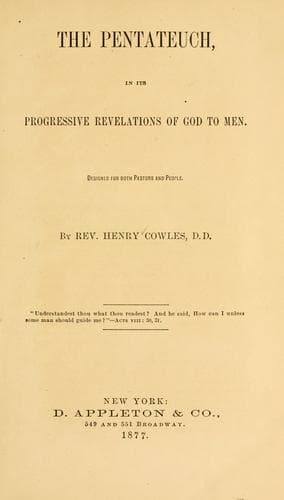
The Pentateuch, in Its Progressive Revelations of God to MenCowles, Henry
Religion
The Pentateuch, in Its Progressive Revelations of God to Men
Cowles, Henry
Bible. Pentateuch -- Criticism, interpretation, etc.
In Ex. 22: 1–15, 25–28, and 23: 4, 5, we have the earliest instalment
of statutes on this point. The staple penalty for theft was restitution,
yet varying widely in amount to meet the peculiarities of the case. In
pastoral life cattle were specially exposed; therefore the law ordained
that if the thief had killed the animal or sold it, he must restore――of
oxen five for one; of sheep, four. But if the animal was found alive
in his hand, the restitution was only double――two for one. The law made
the charitable supposition that the thief might yet repent and bring
back the stolen property, and purposely favored this result. On the
other hand the selling or destruction of the animal would indicate a
fixed purpose to have the avails of it, and also to render detection
more difficult――both of which purposes the law punished sharply.――――It
may well be noted that restitution was a telling, stinging penalty,
touching the sensibilities of the thief in a very tender point. The
indolent or unprincipled man who thought to live upon his neighbor’s
toil, would find stealing very unprofitable. The law had the more grip
in those times because if a man tried to put his property out of his
hands to evade the demand for restitution, or were in fact too poor
to restore four or five fold, there was always the last resort――the
law could take him for a slave (“servant”) and make him _work it
out_.――――This was one of the incidental benefits of a hard system: it
could be applied so as to make the penalties for theft very effectually
stringent.
The law punished trespass upon another’s property and want of care for
its due protection――on which points, subsequent, statutes reaffirm and
expand what we first find in Ex. 22. (See Deut. 22: 1–4.)
* * * * *
While the law was vigorous, not to say severe, against criminal theft,
it was yet _exceedingly lenient towards the unfortunate and innocent
poor_, _e. g._,
(1.) It gave permission to eat another’s property for the supply of
present want. The specifications are――The grapes of thy neighbor’s
vineyard; and his standing corn. Thou mayest eat grapes, but not put
one in thy vessel; mayest pluck the heads of grain in thy hand, but
never move thy sickle against thy neighbor’s grain (Deut. 23: 24, 25).
Public-domain text, read in full here on John Shaqi.
Reviews
Reviews
No reviews yet
Be the first to share your thoughts on this work.
Elsewhere in the archive
Join the Discussion
Join the discussion
Sign in to leave a comment or review.
Sign InorCreate an account