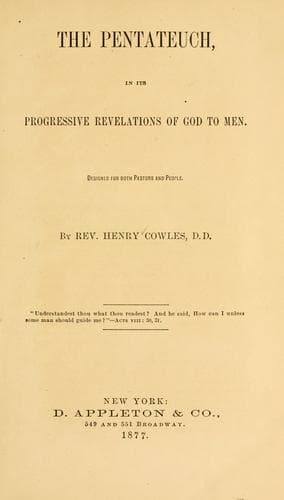
The Pentateuch, in Its Progressive Revelations of God to MenCowles, Henry
Religion
The Pentateuch, in Its Progressive Revelations of God to Men
Cowles, Henry
Bible. Pentateuch -- Criticism, interpretation, etc.
(2.) It regulated thoughtfully and compassionately the whole subject
of _pledges_, _i. e._ securities for the payment of debt. As first
announced (Ex. 22: 26, 27), it provided that if the poor man’s garment
were taken in pledge, it must certainly be restored to him by sundown,
because it was his bed-covering for the night; and God would surely
hear the poor man’s cry if he were compelled to lay himself down to
sleep with no covering.――――As subsequently revised or enlarged (Deut.
24: 6, 10–13, 17), the statute peremptorily forbade taking the upper
or the nether millstone in pledge, because no oriental family could
subsist without these. It also forbade the creditor to go in to the
poor man’s house to get his pledge lest he fix his covetous eye on
something there, but required him to wait patiently outside for the
poor man to bring it out――a provision which manifests a specially
delicate regard for the feelings of the poor. He was not obliged to
expose his deep poverty, nor to disclose all he had to the greedy gaze
of his more wealthy neighbor.――――The law also forbade the taking of a
widow’s raiment in pledge.
(3.) The law was entirely explicit and positive in its prohibition of
_usury_. By “usury” the Hebrew meant, not merely excessive or illegal
interest, but _interest_ itself――_all_ interest――money paid for the use
of money, or any thing valuable paid for the use of any other property
borrowed.――――The first statute (Ex. 22: 25) was general, yet fully
covered the principle: “If thou lend money to any of my people that
is poor by thee, thou shalt not be to him as an usurer, neither shalt
thou lay upon him usury.” The law contemplated the poor only; for the
rich are presumed to be above the necessity of borrowing money. The
borrowing of money as capital to be used in trade, or in manufacture,
or in the purchase of land, had no place at all in the business economy
of Israel. The borrowing which the law contemplated was only that
of the poor man to meet his imperative necessities. A man who had no
accumulations to draw from for a sick day or a casualty, must borrow or
go hungry. God speaks of such poor as “my people,” and forbids taking
interest on what they must needs borrow.
Public-domain text, read in full here on John Shaqi.
Reviews
Reviews
No reviews yet
Be the first to share your thoughts on this work.
Elsewhere in the archive
Join the Discussion
Join the discussion
Sign in to leave a comment or review.
Sign InorCreate an account