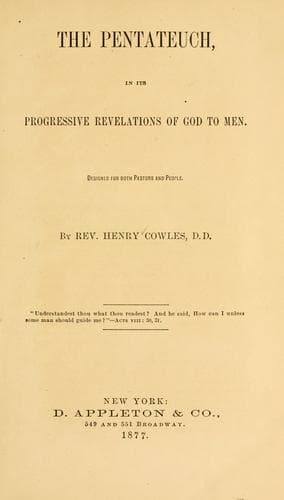
The Pentateuch, in Its Progressive Revelations of God to MenCowles, Henry
Religion
The Pentateuch, in Its Progressive Revelations of God to Men
Cowles, Henry
Bible. Pentateuch -- Criticism, interpretation, etc.
Tale-bearing, _i. e._ tattling, retailing scandal maliciously or
for a past-time, needed the force of law to abate and suppress it
in those times as in most other ages. “Thou shalt not go up and down
as a tale-bearer among thy people, neither shalt thou stand against
the blood of thy neighbor. I am the Lord” (Lev. 19: 16–18)――“Standing
against the blood,” must mean――taking ground against the very life,
and must not be construed to forbid truthful testimony against the
real murderer. But the informer should constantly remember that his
neighbor’s interests and life are too precious to be lightly tampered
with. Thy neighbor may have said or done something wrong. Your duty
in the case is not to scatter broadcast all you know and more than
you know of his misdeeds; but first of all――“Thou shalt not hate thy
brother in thy heart,” but “love him as thyself” (v. 18); and next,
“Thou shalt in anywise [by all means] rebuke thy neighbor, and not
suffer sin upon him.”――――This last clause has been understood in two
ways:――(a) Thou shalt not suffer the sin to lie upon him with no effort
on thy part to bring him to repentance: or (b) Thou shalt not bear on
thine own conscience the sin of neglecting to admonish him; _i. e._
thou shalt not submit to bear this sin on his account――a sin which
comes of knowing his crime and of failing in your duty to save him
by means of judicious and fraternal rebuke. The latter construction
is best sustained by Hebrew usage of the words. See the same words,
Lev. 22: 9 and Num. 18: 32, and the preposition “_upon_ him,” in Ps.
69: 8――“_For thy sake_ have I borne,” etc. The verb in this clause
means rather to “_bear_” in your own person, than to “suffer” to exist
in another.――――The passage, so interpreted, assumes it to be your
solemn duty to labor to bring your neighbor to repentance if you are
cognizant of his wrong-doing, and implies that you must lie under a
load of sin if you fail to do so. But do it _in love_ (loving him even
as yourself) as well as in all fidelity to his soul, as also to your
own. Do this instead of going up and down to scatter this scandal among
those who will do nothing to save your erring neighbor, and nothing to
relieve your conscience of your responsibility in his behalf.
While this statute bears against giving information about misdeeds of
minor sort, there were two crimes of such magnitude that every man was
bound to testify in the proper form against them; viz. idolatry and
murder. See the case of idolatry in Deut. 13: 6–14: “Neither shalt
thou conceal him, but thou shalt surely kill him: thy hand shall be
first upon him to put him to death, and afterward, the hand of all the
people.” (Also v. 14)――――The expiation for murder by an unknown hand
included this most solemn protestation: “Our hands have not shed this
blood, neither have our eyes seen it.” Of course, whoever might have
seen was most sacredly bound to testify.
CHAPTER XVIII.
Public-domain text, read in full here on John Shaqi.
Reviews
Reviews
No reviews yet
Be the first to share your thoughts on this work.
Elsewhere in the archive
Join the Discussion
Join the discussion
Sign in to leave a comment or review.
Sign InorCreate an account