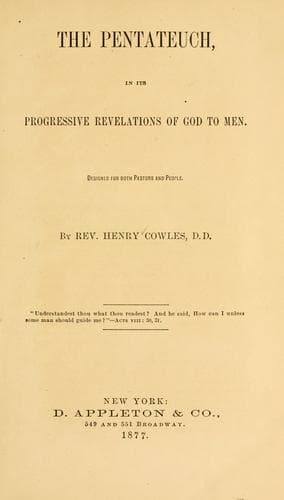
The Pentateuch, in Its Progressive Revelations of God to MenCowles, Henry
Religion
The Pentateuch, in Its Progressive Revelations of God to Men
Cowles, Henry
Bible. Pentateuch -- Criticism, interpretation, etc.
The law of the Jubilee gave personal liberty to all bondmen. Of this,
more must be said under “Hebrew servitude.” It also provided for the
return of all real estate――all the lands of Canaan――to their original
possessors. Lands could be alienated only till the jubilee. They were
sold, if at all, subject to this law. Consequently a sale of land was
only a lease for at longest forty-nine years――_i. e._ for the years
intervening till the next jubilee. They were subject to redemption at
any time――the price to be graduated by the years which the lease had
to run. Houses in walled cities were redeemable only within one year
from sale; but in unwalled cities, houses followed the law of land,
returning with the land to their original owner at the jubilee. The
houses of Levites were accounted as land.――――These statutes had a
twofold purpose; to afford relief to the poor; and to prevent the
entire alienation of the lands of Canaan from the tribes, families,
and individuals to whom they were originally given.――――The question,
how far these institutions――the Sabbatic year and the Jubilee――were
observed in the future history of Israel is foreign from our present
purpose.
VI. _Crimes against reputation_;
(the details of the ninth commandment).
Here are stringent statutes against _false accusation_ and
_false witness_. Under this general head fall two distinct
cases:――(a) Testimony given to favor the guilty (Ex. 23: 1, 3);――――and
(b) allegations designed to condemn the innocent (Deut. 19: 16–21).
(a.) The former class (as given Ex. 23: 1, 3) forbids not merely
originating (“raise”), but _taking up_ a false report and seconding
it by indorsement. It warns men not to be drawn in to help the wicked
in their malicious plots to screen each other, though they be many.
The cause of the poor man which you may not favor (v. 3) is certainly
supposed to be a bad one. Your sympathy for him as poor must not
override justice and truth.
(b.) False witness, purposed to condemn the innocent, is met by
the statute (Deut. 19: 16–21). The accuser and the accused are to be
brought face to face before the Lord and before the priests and the
judges who are to “make diligent inquisition,” obviously hearing both
parties, and if the accuser is proved to be a false witness, “Ye shall
do to him as he thought to do to his brother; thine eye shall not pity,
but life shall go for life; eye for eye,” etc.
Public-domain text, read in full here on John Shaqi.
Reviews
Reviews
No reviews yet
Be the first to share your thoughts on this work.
Elsewhere in the archive
Join the Discussion
Join the discussion
Sign in to leave a comment or review.
Sign InorCreate an account