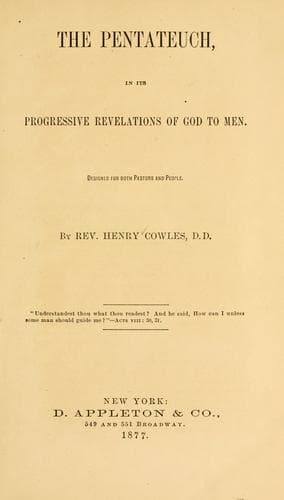
The Pentateuch, in Its Progressive Revelations of God to MenCowles, Henry
Religion
The Pentateuch, in Its Progressive Revelations of God to Men
Cowles, Henry
Bible. Pentateuch -- Criticism, interpretation, etc.
2. The Hebrew law positively forbade the rendition of fugitives.
“Thou shalt not deliver to his master the servant that has escaped
from his master unto thee: he shall dwell with thee, even among you in
that place which he shall choose in one of thy gates where it liketh
him best; thou shalt not oppress him” (Deut. 23: 15, 16).――――Observe
it was not only impossible to have any law for the reclamation of
fugitives――_i. e._ to have “a fugitive slave law” of the recent
American pattern; but the law was put on the other side. It
declared――“Thou shalt _not_ deliver him up to his master”――shalt not
give his master information and help the arrest; but shalt let him
choose his abode by his own free and manly will. If his hardships are
such under his bondage that he prefers to take his risk of finding a
better living elsewhere, let him try it. Let no man stand in his way.
He would not leave his master if his personal rights and interests were
properly cared for. But if his master is too selfish, or too cruel, or
too exacting of labor, or too stingy of bread or clothing, who shall
judge but the servant himself? Therefore let the servant better his own
condition if he can, and let all selfish, savage-hearted masters take
warning!――――Such laws exorcise the real spirit of slavery with blessed
rapidity. It would require but few such ameliorating statutes to tone
it down from unendurable slavery to very tolerable servitude.
The spirit of this law is altogether the spirit of the Great Lawgiver
when he found the Hebrews sorely oppressed in Egypt; smote off their
chains; brought them forth from their house of bondage, and placed them
beyond all reclamation. What he required his people now to do in behalf
of any oppressed servant was only in spirit what he had done for them.
3. Severe personal injuries gave the slave his freedom. “If a man smite
the eye of his servant or the eye of his maid that it perish, he shall
let him go free for his eye’s sake.” So of the tooth (Ex. 21: 26, 27).
The eye and the tooth are but specimen illustrations of the principle.
A charge of shot in the leg could not be less under this law than
a passport to freedom.――――Moreover, the statutes very specifically
enjoined clemency and forbade rigor in the treatment of Hebrew servants
(Lev. 25: 39–43, 46).
Public-domain text, read in full here on John Shaqi.
Reviews
Reviews
No reviews yet
Be the first to share your thoughts on this work.
Elsewhere in the archive
Join the Discussion
Join the discussion
Sign in to leave a comment or review.
Sign InorCreate an account