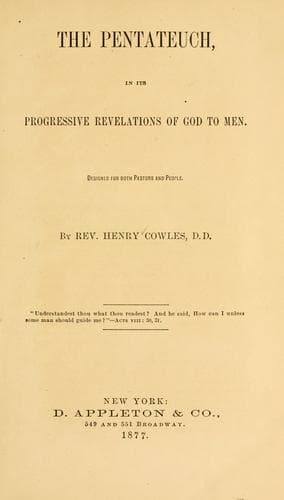
The Pentateuch, in Its Progressive Revelations of God to MenCowles, Henry
Religion
The Pentateuch, in Its Progressive Revelations of God to Men
Cowles, Henry
Bible. Pentateuch -- Criticism, interpretation, etc.
4. Of wider sweep in its influence and of inexpressible value was
_the system of periodical emancipation_. The term of service for the
Hebrew-born was limited to six years. At the end of this term they went
out free. Servants of foreign birth (as we shall see) went out at the
Jubilee, each fiftieth year.――――The effect of this law was at once to
lift from the heart the terrible incubus of a life-long bondage――that
sense of a hopeless doom which knows no relief till death. Whatever the
amount of discomfort or suffering involved in servitude might have been,
the Hebrew servant had under this law the prospect of his freedom at no
distant day.――――Moreover the accompanying provisions of this law were
thoroughly humane. The servant who had sold himself through extreme
poverty (Lev. 25: 47–55) might be redeemed at any time by a friend,
or if he could command the means by extra labor or skill, he might
redeem himself.――――When his term expired, his master must not send him
away empty, but must furnish him liberally out of his flock and out
of his floor (grain), and even out of his _wine-press_――of any thing
and every thing wherewith the Lord had blessed the master, he was to
impart liberally to his manumitted servant (Deut. 15: 12–15). So the
servant would have a fair start in his new self-supporting life. It
was a fore-thoughtful provision, full of the milk of a more than human
kindness.
Apparently this periodic emancipation applied to every class of Hebrew
servants――to him who had sold himself because he had become too poor
to provide for his family; to him who had been taken and sold for debt;
and to him who had been sold into servitude for crime. This latter case,
however, is doubtful.
Noticeably, this law provides for the family rights of the servant. If
he had brought his wife with him into this state, he took her out with
himself, and of course his children also. If his master had given him a
wife, he retained her because of his property interest in her services,
and her children with her for humanity’s sake; for children under six
years of age need their mother’s care. Wives in that age of the world
were paid for.
Public-domain text, read in full here on John Shaqi.
Reviews
Reviews
No reviews yet
Be the first to share your thoughts on this work.
Elsewhere in the archive
Join the Discussion
Join the discussion
Sign in to leave a comment or review.
Sign InorCreate an account