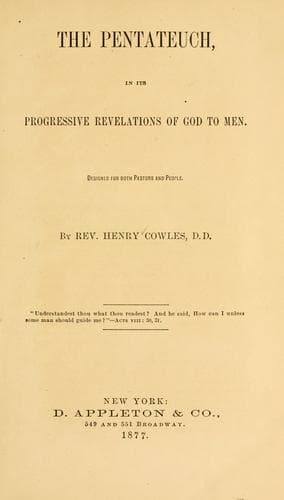
The Pentateuch, in Its Progressive Revelations of God to MenCowles, Henry
Religion
The Pentateuch, in Its Progressive Revelations of God to Men
Cowles, Henry
Bible. Pentateuch -- Criticism, interpretation, etc.
3. The processes of prosecution are not specially described. In cases
of a personal, private character, the aggrieved party brought suit. In
cases of a public nature “the elders of the city” bore responsibilities,
as we see in the case of murder by an unknown hand. A remarkable case
of appeal to the sensibilities of the whole nation is given Judg.
19: 25–30, under which the people woke to a consciousness of horrible
wickedness in Israel, and their indignation became irrepressible; yet
they carefully sought counsel of the Lord in this terrible case.
4. _Advocates._ We find no notice of professional advocates. The
“lawyers” of New Testament history were men versed in the law and
were teachers of law, but not by any means the modern advocate. Every
man might be his own advocate, and even women were heard before no
less a king than Solomon himself (1 Kings 3: 16–18). Noble-hearted,
disinterested men seem in Oriental life to have undertaken this service
voluntarily for the poor and the fatherless, of which Job gives a
touching description (Job 29: 7–17). Isaiah exhorts to this duty:
“Plead for the widow” (1: 17). It was the noble doctrine of this
system――“Our law judges no man before it hears him and knows what he
doeth” (Jn. 7: 51). Moses puts it thus――“Ye shall hear the small as
well as the great” (Deut. 1: 17). “If there arise a matter in judgment
between blood and blood, _between plea and plea_,” etc. (Deut. 17: 8).
5. _Of Witnesses_――the points of chief importance are these:
(1.) They testified under oath――the manner of administration being this:
The witness listened to the rehearsal of the words, and gave his oral
assent, “Amen,” or, “As thou sayest.” The passage (Lev. 5: 1) describes
the case of one who sins in this way, hearing the voice――_i. e._ the
words of the sacred oath, adjuring him to testify whether he has seen
or known any thing in this case. Then if he will not make known, “he
shall bear his iniquity.”――――A special statute for the case of a wife
suspected of conjugal infidelity shows how she is to be put under this
solemn oath (Num. 5: 19–22). She listens to the words of the oath and
responds, “Amen, amen.” (See also Prov. 29: 24 and Mat. 26: 63).
(2.) That the witnesses were examined separately and in presence of
the accused appears probable from a comparison of Mat. 26: 61 with
Mk. 14: 55–59. Jesus was present (Mat. 26: 62).
(3) As to the requisite number of witnesses――a criminal case of capital
crime required two besides the accuser (Deut. 17: 6 and 19: 15). Hence
the phrase――“In the mouth of two or three witnesses shall every word
be established” (Mat. 18: 16).――――A supposed case is stated (Ex. 22:
10, 11) in which the complainant and the accused are the only witnesses.
Both are put under oath; but the testimony of the accused under oath
seems to be accepted as his vindication.
Public-domain text, read in full here on John Shaqi.
Reviews
Reviews
No reviews yet
Be the first to share your thoughts on this work.
Elsewhere in the archive
Join the Discussion
Join the discussion
Sign in to leave a comment or review.
Sign InorCreate an account