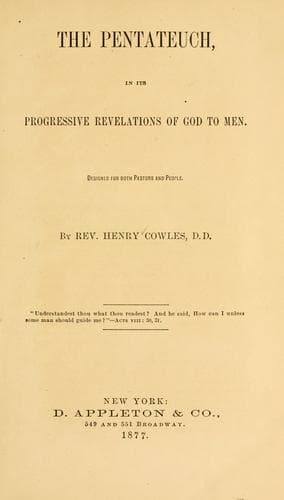
The Pentateuch, in Its Progressive Revelations of God to MenCowles, Henry
Religion
The Pentateuch, in Its Progressive Revelations of God to Men
Cowles, Henry
Bible. Pentateuch -- Criticism, interpretation, etc.
Under this general head the following topics should receive attention.
1. _Judges._ The reorganization suggested by Jethro has been noticed,
and also its further modification to adjust it to the fixed residence
in Canaan.――――Between Joshua and Saul, there was an irregular series
of Supreme Judges, closing with Samuel of whose circuit court, taking
four cities in rotation, we have a notice in 1 Sam. 7: 15–17. The kings
manifestly held this function of Supreme Judge. In the absence of other
Judges, the High Priest seems to have served ex-officio. His powers,
under the “Judges” above referred to and the kings, are not sharply
defined; but probably religious and semi-religious questions came
before him and his associates. The Judges between Joshua and Samuel
were military men.――――A special reorganization of the judiciary under
Jehoshaphat (2 Chron. 19: 5–11) will repay a careful reading. It
provides subordinate judges in all the fortified cities; solemnly
admonishes them to administer justice in the fear of God; establishes
a supreme court in Jerusalem, where “he set of the Levites, priests,
and chief of the fathers of Israel for the judgment of the Lord and
for controversies when they returned to Jerusalem”――the last clause
apparently referring to cases carried up for decision before this
supreme court.――――It should be noted that we read nothing of cases
taken up to a higher court by appeal of a dissatisfied party; but only
as carried up by the lower court itself when the case seemed too hard
or too high for its decision. This principle went into operation in the
reorganization by Moses (Ex. 18: 22, 26 and Deut. 1: 17)――“The cause
that is too hard for you, bring it to me and I will hear it.” It passed
into the general law as we may see (Deut. 17: 8–13) which provides for
a supreme court at the religious center, the judges being “the priests,
the Levites, and the judges that shall be in those days.”
The warnings against partiality and bribery were earnest and
solemn――the penalty for these offenses being left, it would seem,
to be visited upon the offender by the Almighty (Ex. 23: 6–8, and Lev.
19: 15, and Deut. 1: 17, and 16: 18–20). They were not even allowed to
favor the poor man in his cause _against justice_ (Ex. 23: 3 and Lev.
19: 15)――there being sometimes a temptation to do this out of sympathy
with his poverty and his necessities. But God put justice in law above
sympathy for even the necessitous poor.――――The public anathema fell on
him who took a bribe to slay the innocent (Deut. 27: 25).
2. The seat of justice――the place for holding court――was “in the gates
of the city.” Hence this being with all Orientals the place of public
resort, the courts were public――open to all.
Public-domain text, read in full here on John Shaqi.
Reviews
Reviews
No reviews yet
Be the first to share your thoughts on this work.
Elsewhere in the archive
Join the Discussion
Join the discussion
Sign in to leave a comment or review.
Sign InorCreate an account