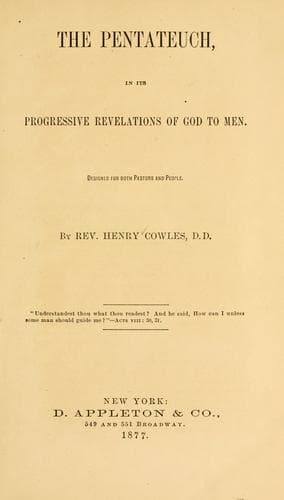
The Pentateuch, in Its Progressive Revelations of God to MenCowles, Henry
Religion
The Pentateuch, in Its Progressive Revelations of God to Men
Cowles, Henry
Bible. Pentateuch -- Criticism, interpretation, etc.
3. _Stripes_ were made the penalty of certain specified crimes (Lev.
19: 20 and Deut. 22: 18). The law was careful to limit the number of
stripes to forty, giving as the reason――“Lest if thou shouldest exceed”
[this number] “then thy brother should seem vile unto thee;” _i. e._
not merely lest the man might lose his self-respect, but lest he lose
the respect of the community, and be hopelessly degraded. In usage
the Hebrews limited the number to thirty-nine――said to have been
administered by thirteen strokes of a triple cord.
4. Of retaliation [“lex talionis”] notice has been taken already.
5. _Excommunication_; excision; being cut off from his people. When
executed by God himself, it meant destruction by some providential
agency. Compare 1 Kings 14: 10 with 15: 29 and 2 Kings 9: 8–10.――――When
executed by human agency, it was capital punishment, usually by stoning
(Ex. 31: 14, and Lev. 17: 4, and 20: 17, 18).
6. The customary modes of capital punishment were two: _stoning_ and
_the sword_. (Deut. 13: 9, 10, and 17: 5, and Josh. 7: 25.) The sword
appears in later ages.
7. _Disgrace after death_ in some cases heightened the penalty,
_e. g._ by burning the dead body (Gen. 38: 24, and Lev. 20: 14, and
21: 9). That in these cases the death was by stoning and the burning
was only that of the dead body, seems to be sufficiently proved from
Josh. 7: 15, 25. “All Israel stoned him” [Achan and his family] “with
stones and burned them with fire _after_ they had stoned them with
stones.” Their very bodies seem to have been thought of as polluted and
_polluting_.――――Another method of posthumous disgrace was by hanging on
a tree (Num. 25: 4, 5 and Deut. 21: 22, 23). The body must not remain
suspended over night “that thy land be not defiled; for he that is
hanged is accursed of God.” See cases of the execution of this law in
Josh. 8: 29 and 10: 26, 27.
Several forms of punishment were introduced from other nations in later
ages which we may omit as foreign from our subject.
In closing this topic let it be noted that judicial procedure and
punishment were summary――both the trial and the execution being carried
through with apparently no delay. Compared on these points with the
most highly civilized countries of our age, the Hebrews have greatly
the advantage, and the efficiency of their law must have been for this
very reason surpassingly great. Their methods afforded but the smallest
possible hope of escape. Punishment followed close on the heels of
detection, and usually, we must presume, of crime.――――Furthermore,
these punishments, compared with those of other nations in that age
were by no means severe. Indeed the modes of capital punishment which
come to view in the Scriptures as existing among other nations were
terribly barbarous compared with those of the Hebrew code; _e. g._
burning in a fiery furnace; being torn in pieces by lions; being sawn
asunder; crucifixion.
Public-domain text, read in full here on John Shaqi.
Reviews
Reviews
No reviews yet
Be the first to share your thoughts on this work.
Elsewhere in the archive
Join the Discussion
Join the discussion
Sign in to leave a comment or review.
Sign InorCreate an account