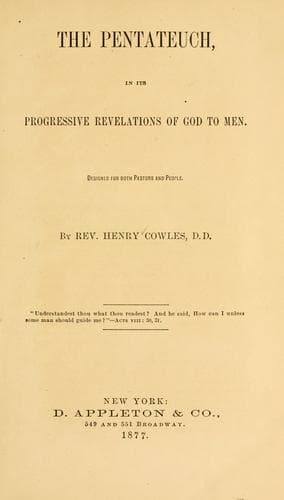
The Pentateuch, in Its Progressive Revelations of God to MenCowles, Henry
Religion
The Pentateuch, in Its Progressive Revelations of God to Men
Cowles, Henry
Bible. Pentateuch -- Criticism, interpretation, etc.
The design of punishment is put in the plainest terms. In its severer
forms it is not the discipline of the criminal but the good of the
public――to deter the evil-minded from crime and so to make society safe
from outrage. In the case of presumptuous sins we read――“That man shall
die, and thou shalt put away the evil from Israel, and all the people
shall hear and fear and do no more presumptuously” (Deut. 17: 12, 13
and 19: 20).
It is worthy of special notice under this head that we find in this
code a considerable number of statutes _with no penalty attached_ which
human hands were to inflict. God reserved the infliction of the penalty
to himself. The fear of his displeasure, coupled with his promised
rewards for obedience were the only forces coercing obedience to these
statutes. They were left upon the conscience of the people, and upon
their fears and hopes under a system in which God’s hand in providence
was often made most palpable. For cases in point I may refer to the
laws against usury and requiring favors to be shown to the poor;――as
for example (Deut. 15: 9, 10): “Beware that there be not a thought in
thy wicked heart, saying――The seventh year, the year of release is at
hand, and thine eye be evil against thy poor brother and thou givest
him naught, and he cry unto the Lord against thee and it be sin upon
thee. Thou shalt surely give him, and thine heart shall not be grieved
when thou givest unto him; because that for this thing the Lord thy God
will bless thee in all thy works,” etc.
Public-domain text, read in full here on John Shaqi.
Reviews
Reviews
No reviews yet
Be the first to share your thoughts on this work.
Elsewhere in the archive
Join the Discussion
Join the discussion
Sign in to leave a comment or review.
Sign InorCreate an account