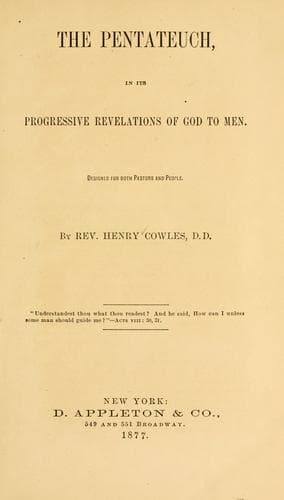
The Pentateuch, in Its Progressive Revelations of God to MenCowles, Henry
Religion
The Pentateuch, in Its Progressive Revelations of God to Men
Cowles, Henry
Bible. Pentateuch -- Criticism, interpretation, etc.
The moral power of this invisible force upon the heart and conscience
of the people we shall be able to appreciate more justly if we
carefully study the words which stand (Ex. 23: 20–25), _i. e._ at the
close of the first catalogue of the “statutes and judgments.” It seems
to come in here legitimately as a moral force to induce a conscientious
and careful obedience to these statutes. “Behold” (calling special
attention) “behold, I send an angel before thee to keep thee in the
way, and to bring thee into the place which I have prepared. Beware of
him, and obey his voice; provoke him not, for he will not pardon your
transgressions, for my name is in him. But if thou shalt indeed obey
his voice and do all that I speak, then I will be an enemy to thine
enemies,” etc.――――This angel, bearing authority to pardon or not pardon
sins, and of whom the very God could say――“My name is in him” could
be no less than really divine. _Name_ in Hebrew usage as applied to
God involves and implies his real nature――his essential attributes.
Corresponding to this view of “the angel” in this passage is the
injunction to “beware of him and to obey his voice”; and also his power
to forgive sins――“for who can forgive sins but God only”? This passage
therefore affords decisive proof that the personage who manifested
himself to Israel in the pillar of cloud and of fire; whose presence
abode in their tabernacle; whose voice they heard in this holy law――was
truly divine, and yet was mysteriously distinct from the speaker――the
“I”――of this remarkable passage. Truly he was God, manifest――if
not precisely in human flesh――yet in palpable forms, in tangible
demonstrations, in voice of power and tongue of flame; in the luminous
pillar; in perpetual agencies of protection and of supply as to earthly
need; and, not least, as their Ruler and their Lord whose voice in
these statutes it behooved them to hear and obey as they would hope
to be blessed in their national life and in any desirable prosperity.
Hence it was both practicable and wise under this Hebrew system to
leave some statutes upon the naked conscience of the people with no
attempt to enforce obedience save the appeal to this invisible Presence.
These remarks will naturally suggest to the thoughtful mind a train
of inquiries of this sort:――――How can we account for it that the books
of Moses allude so very rarely to the future state of man’s being――to
heaven and to hell? Had even the best men of those times any definite
belief in the future life and in its retribution for deeds done in
this? How happens it that both the law and the rewards or penalties
of their civil code, and indeed of their religious code as well, make
so much account of present retribution and so little of the future?
Public-domain text, read in full here on John Shaqi.
Reviews
Reviews
No reviews yet
Be the first to share your thoughts on this work.
Elsewhere in the archive
Join the Discussion
Join the discussion
Sign in to leave a comment or review.
Sign InorCreate an account