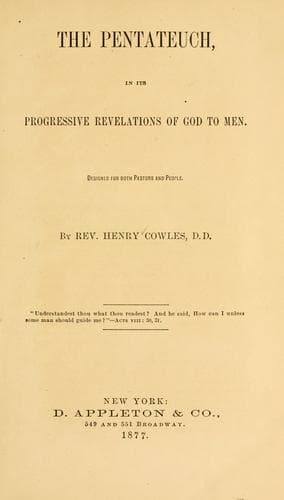
The Pentateuch, in Its Progressive Revelations of God to MenCowles, Henry
Religion
The Pentateuch, in Its Progressive Revelations of God to Men
Cowles, Henry
Bible. Pentateuch -- Criticism, interpretation, etc.
3. Egypt gave to the children of Israel the example of a national life
_based on agriculture_, as distinct from and indeed opposed to the
wandering, unsettled life of the shepherd. The nomadic mode of life,
perpetuated by necessity to this day in the deserts of Arabia, in which
individual right to the soil is unknown and no family has a fixed home,
each living for the time where its flocks may chance to find herbage
and water――this had been the style of the patriarchs before Jacob went
to Egypt. It was not the best for social and mental culture. God had a
better life for his people prospectively in Canaan, and their residence
in Egypt introduced them to it and gave them a preparation for it. It
made subsistence less precarious; blended the cultivation of the soil
with the care of flocks and herds; provided for a denser population;
greatly enhanced the opportunities for social culture and for such a
religious system as that of Israel. In a word it provided for a much
higher Christian civilization than could have been possible under the
strictly nomadic mode of life. To Egypt, the nation was indebted for
the example and for the training into this agricultural mode of life.
4. In another important respect, the example of the national life
of Egypt was a preordained training for their own national life in
Canaan:――it was that of a people providing for their own wants; living
within themselves; maintaining substantially non-intercourse with
other nations, and for the most part excluding foreign commerce. Such
was Egypt during the residence of Israel there, and such God wisely
designed Israel to be in her promised land of Canaan. As to Israel
in Canaan, the purposes of this policy are obvious――protection from
the contaminating influences of idolatry, not to say also from the
contaminations of luxury and wealth.
5. In Egypt, the priests were the learned class of the empire, and
held the highest responsibilities in the civil and judicial as well
as the religious life of the nation. A system essentially the same was
introduced into Israel, the priests and the Levites holding the same
place in the nation which they had seen held by the priests in Egypt.
6. It is a very noticeable fact in the history of the legal life in
Egypt, that though magic arts were in a sense tolerated and indeed
were resorted to by the king in his emergencies, yet their influence
in society proved to be so pernicious as to demand legal restraint.
We have the record of a man indicted “for many crimes and wickednesses
committed through his magic arts and writings, such as paralyzing limbs,
empowering a slave to do audacious things,” etc. The decision of the
court in his case reads――“For his various abominations, the greatest
in the world, he is condemned to death.”――――It will be remembered that
the Mosaic law held _all_ practice of magic arts to be a penal offense,
punishable with death (Ex. 22: 18 and Lev. 20: 27).
Public-domain text, read in full here on John Shaqi.
Reviews
Reviews
No reviews yet
Be the first to share your thoughts on this work.
Elsewhere in the archive
Join the Discussion
Join the discussion
Sign in to leave a comment or review.
Sign InorCreate an account