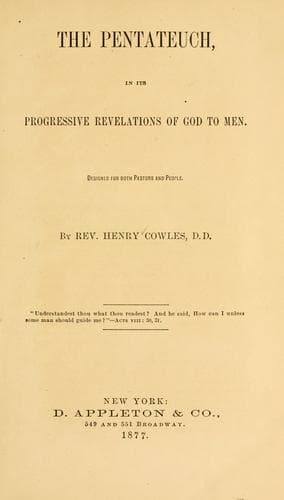
The Pentateuch, in Its Progressive Revelations of God to MenCowles, Henry
Religion
The Pentateuch, in Its Progressive Revelations of God to Men
Cowles, Henry
Bible. Pentateuch -- Criticism, interpretation, etc.
7. In some points the spirit of the Mosaic code was so greatly in
advance of the Egyptian as to stand related to it, not in the way
of imitation or even modification, but of direct opposition. It
held squarely the opposite doctrine and put forth statutes of an
opposite character. Thus, the Egyptian code legalized slavery, and
had its special law for the reclamation of fugitives. Among the
recent discoveries in Egyptian antiquities “A warrant for the arrest
of fugitive slaves” has been brought to light. From the tone of this
warrant and from other evidence, collateral, it is inferred that
slave-holders were obliged by law to register them in a list kept by
government and disputes with regard to ownership must be brought before
the judges. The rights of the master in his slave were not absolute.
It was not by virtue of orders direct from the owner that search was
instituted and arrest made, but by the authority of a high functionary
of government, to whom the case is reported and who issues his mandate.
Thus the government itself put forth its hand to recover a slave
who had escaped from any citizen.――――It was therefore specially
pertinent that the law of Jehovah to Israel should plant itself on
ground precisely the reverse of this:――_no reclamation of fugitives
whatsoever_. Thou shalt _not_ do what Egyptian slave-holders were
authorized by the highest authority of the kingdom to do――force back
the escaped fugitive to his unendurable bondage.
In the line of their religious institutions Israel stood related to
Egypt in numerous particulars, borrowing some things for the adornment
of its tabernacle from Egyptian art; and on the other hand, guarding
by stringent prohibitions against many Egyptian usages associated with
idolatry. These points will be in place after we have considered the
religious institutions of Moses.
II. The second proposed historic question, viz. How far have the best
civil codes of all history and how far has the world at large been
indebted to this Hebrew code?――opens a field of inquiry quite too wide
to be fully canvassed within our prescribed limits. A few hints may
be useful perhaps to guide the further inquiries of the reader. The
following points are put comprehensively and suggestively:
1. Moses sought to impress it upon his people that this system far
surpassed that of any other nation. “Behold, I have taught you statutes
and judgments, even as the Lord my God commanded me.... Keep, therefore,
and do them, for this is your wisdom and understanding in the sight
of all the nations who shall hear of all these statutes and shall say,
Surely this nation is a wise and understanding people, for what great
nation hath their God so nigh to them as the Lord our God is to us
in all that we call upon him for? And what great nation hath statutes
and judgments so righteous as all this law which I set before you this
day”? (Deut. 4: 5–8.)
Public-domain text, read in full here on John Shaqi.
Reviews
Reviews
No reviews yet
Be the first to share your thoughts on this work.
Elsewhere in the archive
Join the Discussion
Join the discussion
Sign in to leave a comment or review.
Sign InorCreate an account