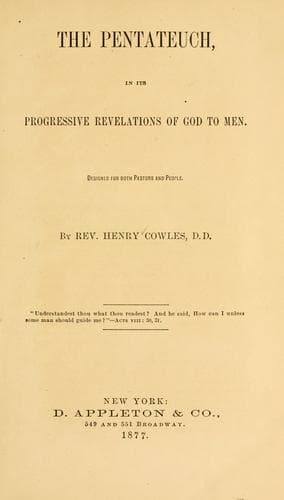
The Pentateuch, in Its Progressive Revelations of God to MenCowles, Henry
Religion
The Pentateuch, in Its Progressive Revelations of God to Men
Cowles, Henry
Bible. Pentateuch -- Criticism, interpretation, etc.
(d.) This dispersion of the Jews at and after their captivity planted
them in large numbers in the chief seats of human science and learning;
in Egypt on the South-West; in Babylon, Persia, and adjacent countries
of the East. It is historically certain that in the age of the
Ptolemies, a large body of learned Jews lived in Egypt; that the Old
Testament was translated into Greek by request of Ptolemy Philadelphus;
that the Egypt of that age was the school of wisdom and jurisprudence
for Ancient Greece and was herself the pupil of Moses.[43]――――That
the best Greek authors knew Moses is matter of history. Longinus
quotes from Moses (Gen. 1: 3) in his treatise on Sublimity; Strabo
makes honorable mention of him as a law-giver; and Diodorus Siculus
acknowledges him to be “the first of legislators from whom all laws
had their origin.” Numenius a Greek philosopher of the Pythagorean
school, speaking of Plato, exclaims――“What is Plato but Moses
Atticising”――_i. e._ teaching in Attic Greek? Origen believed that
Plato drew largely from Moses.――――The list of eminent Grecian authors
and savans who went personally to Egypt for wisdom and science is
long――such as Thales, Anaximander, Anaxagoras, Pythagoras, Plato,
Herodotus. There they came into contact with learned Jews and not
improbably with the writings of Moses.[44] Prof. Wines (p. 335) cites
the learned Grotius as saying――“The most ancient Attic laws, whence
in aftertimes the Roman were derived, owe their origin to Moses’ law.
That the Grecians, especially the Attics, took their laws from Moses
is credible. This is the reason why the Attic laws and the Roman
twelve Tables which sprang from them so much resemble the Hebrew
laws.”――――This similarity between the Attic laws and those of Moses has
been noticed by many other learned men, _e. g._ Josephus, Clement of
Alexandria, Augustine, Sir Matthew Hale, Archbishop Potter. The last
named in his “Grecian Antiquities” has adduced many points of Grecian
law which seem to have been taken from Moses――viz. the laws of divorce;
the purgation oath compared with “the oath of jealousy” among the
Hebrews; the harvest and vintage festival; the law of first-fruits; the
law requiring the best offerings for God; the portion for the priests;
protection to the man-slayer at their altars; requiring priests to be
unblemished; the agrarian law; laws regulating descent of property, and
prohibiting marriage within certain degrees of consanguinity.――――Plato
in his ideal “Republic” is thought to have drawn largely from
Moses.――――Clement of Alexandria accosts him (by Apostrophe)――“But as
for laws, whatever are true were conveyed to thee from the Hebrews.”
These historic facts seem to indicate the definite channel through
which the laws of Moses reached the Grecian mind in its earliest stages
of culture and thus wrought themselves into the great fountains of
Grecian and Roman civilization and jurisprudence.
Public-domain text, read in full here on John Shaqi.
Reviews
Reviews
No reviews yet
Be the first to share your thoughts on this work.
Elsewhere in the archive
Join the Discussion
Join the discussion
Sign in to leave a comment or review.
Sign InorCreate an account