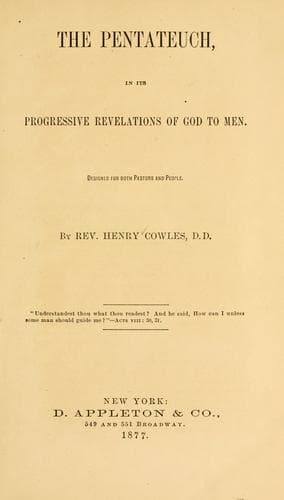
The Pentateuch, in Its Progressive Revelations of God to MenCowles, Henry
Religion
The Pentateuch, in Its Progressive Revelations of God to Men
Cowles, Henry
Bible. Pentateuch -- Criticism, interpretation, etc.
2. The Hebrew system surpassed all others, especially in this――that
_it gave to human government and law the sanction of God’s authority_,
and enforced them upon the human heart and conscience by this most
impressive and benign of all influences.
3. Preparatory to this result it maintained against the whole Pagan
world the doctrine of _one God_――perfect in character, supreme in power,
righteous in all his administration of rewards and punishments. Only
so could it make the idea of God a really wholesome power and his
authority effective in sustaining civil government.
4. This divinely given code rested upon justice and equity, and
determined every thing by this standard. So doing, it ruled out at once
a multitude of interests and ends which human laws have often sought
to secure. Its example therefore, in so far at least, was simply and
supremely beneficent.
5. In yet further detail, it recognized the common and equal rights of
all men, irrespective of condition, rank, wealth――holding constantly
the doctrine, “_No respect of persons_.”
6. It appreciated at their just value the rights of the poor and of all
that large class who look only to God and to human law for protection.
We come now to the question of historic fact: _Did this Hebrew code
and government send forth its influence upon the nations of ancient
history?_ Did it in any perceptible degree leaven the best systems of
human law and jurisprudence.――――If the proof for the affirmative falls
short of positive certainty, what is its amount of probability?
Here we may fitly consider――
(a.) That God chose for Israel the land of Canaan, in the center of the
ancient world of mind; immediately between Egypt on the one hand and
Babylon, Assyria, Persia――all the great nations of Western Asia――on the
other; and closely contiguous to ancient Greece and Rome.
(b.) That David and Solomon became known to all the great powers of the
world of their time. Solomon’s renown turned largely on the fact that
his people were prosperous and happy, his government well ordered, and
his own wisdom in all affairs of state unsurpassed.――――It is simply
impossible that such examples should drop powerless upon the nations of
the earth.
(c.) That at a later period the personal history of Mordecai, of Esther,
and especially of Daniel in the courts of Nebuchadnezzar and of Cyrus
show that the Jews, their religion, their God, and their law, did
impress themselves upon the greatest centers of influence and power in
their time.
Public-domain text, read in full here on John Shaqi.
Reviews
Reviews
No reviews yet
Be the first to share your thoughts on this work.
Elsewhere in the archive
Join the Discussion
Join the discussion
Sign in to leave a comment or review.
Sign InorCreate an account