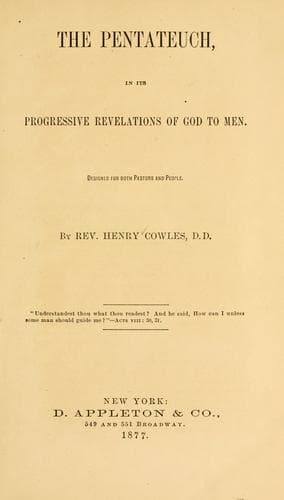
The Pentateuch, in Its Progressive Revelations of God to MenCowles, Henry
Religion
The Pentateuch, in Its Progressive Revelations of God to Men
Cowles, Henry
Bible. Pentateuch -- Criticism, interpretation, etc.
Let us think of the scene at that altar of sacrifice. The place is
in the front court of the tabernacle, whose inner sanctuary was made
glorious with the visible presence of Jehovah. The one all-engrossing
thought associated with this sacred spot, was――_God is here_. I go up
to meet God. Before his face I bring this prescribed offering. It is
one of my sweet lambs of the flock, or as the case may be, a young
bullock of one or two years old. I know that the animal must die there.
Either in my own person or through the priest, acting in my behalf,
I am to lay my hand on the head of the victim and thus confess my sin.
From that moment the innocent lamb takes my place and stands before
the executioner, as if guilty of capital crime. The sight and the smell
of blood; the struggle and the recoil; the outcry of horror――the only
awful, horrible sound uttered by these animals――go to make up a scene
which, once witnessed, can never be forgotten. We of this age might see
it in some of its aspects if we would; we rarely do. We should find it,
not in our worshiping sanctuaries but in the secluded slaughter-house
whither no one is ever attracted――whither none ever go save those who
must. Think of the blood, the death-groans, the struggle, the whole
dying scene. Is there any meaning in it? Is there any thing in it
appropriate to the sanctuary of God and to his solemn worship?
The transaction is by no means so mysterious as it might be. It would
be profoundly mysterious were it not that man is a sinner before the
holy law of God――a sinner under condemnation of death. It would be
utterly inexplicable if there were not in nature, in thought, in fact,
something which we may call substitution, to which we give the name
vicarious――something which involves, not indeed an entire exchange of
one personality for another, but something which approximates toward it.
One being suffers in the place and stead of another. An innocent being
steps into the place of a guilty one and takes upon himself the guilty
man’s doom. We need not pause here to hunt up analogies of this sort
in human life; suffice it that God signifies by these striking symbols
that he has found a place for this principle in his great scheme
for the pardon of sinners condemned to death by his holy law, and
that he saw fit to fill this Hebrew religious system absolutely full
of illustrative typical representations of this stupendous fact.
The elementary facts in this system of sacrifices, considered as
illustrating the scheme of pardon are few and simple; thus――
(a.) Man has sinned against God and stands condemned by his law to
eternal death.
Public-domain text, read in full here on John Shaqi.
Reviews
Reviews
No reviews yet
Be the first to share your thoughts on this work.
Elsewhere in the archive
Join the Discussion
Join the discussion
Sign in to leave a comment or review.
Sign InorCreate an account