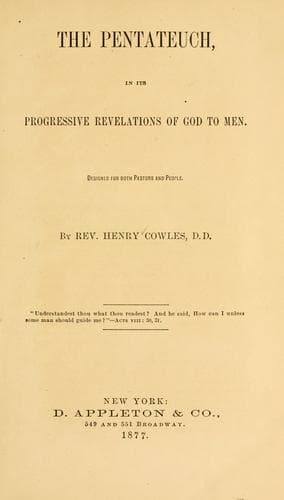
The Pentateuch, in Its Progressive Revelations of God to MenCowles, Henry
Religion
The Pentateuch, in Its Progressive Revelations of God to Men
Cowles, Henry
Bible. Pentateuch -- Criticism, interpretation, etc.
his friends; also by the poor, the widow, servants, etc.:――――(h.) Wave
and heave offerings――terms which refer to ceremonies of elevating or
waving certain parts of the sacrifice.
(5.) A much more important distinction in the Mosaic sacrifices lies
between those which were _expiatory_ and those which were not specially
so, the former class being slain animals whose fat at least was burned
on the altar and whose blood was sprinkled in specified and various
ways; the latter class having somewhat various objects, but chiefly
that of expressing gratitude for blessings or joy in the God of their
salvation.
* * * * *
Two other points in respect to sacrifices are of importance, viz.――
(a.) _The choice of animals to be slain in sacrifice._
(b.) The killing itself, coupled with the use made of the blood, of the
fat, and in some cases of the flesh――with the attendant ceremonies.
(a.) It should be carefully noted that animals for sacrifice were not
taken up at random. It was not merely life and blood that were sought.
They were not the wild, but the tame, domesticated; not the savage,
flesh-eating animals, but the docile, grass-eating; not animals mostly
or altogether useless to man, but precisely those which were most
useful; not animals of the sort nobody loves or cares for, but those
most loved and cared for, between whom and the human family there
often arises a special intimacy and affection. In a word they were the
representatives of utility, docility, and innocence. The ox, patient
of toil, in his early years invaluable for food; the goat, useful
for flesh and milk; the lamb――the symbol of affection, attachment,
innocence:――these three classes of animals formed the staple material
for bloody sacrifice. [Of birds, the turtle-dove and young pigeon,
being less expensive, were permitted to the poor. As naturally
representing innocence and loveliness, they are quite of the same
class].――――It sometimes escapes notice that the Orientals brought these
animals much nearer to their hearts and homes than our Western notions
and habits know of. We forget that not infrequently to this day they
live under the same roof along with sons and daughters. The prophet
Nathan in that touching verse about the “one little ewe lamb” (2 Sam.
12: 3) drew not from his imagination but from Oriental life. “The
poor man had nothing save one little ewe lamb which he had bought and
nourished up, and it grew up together with him and with his children:
it did eat of his own meat” [food] “and drank from his own cup and lay
in his bosom, and was to him as his daughter.”――――Moreover, the Hebrew
might not select for sacrifice the deformed, the torn, the lame, the
sickly; but evermore, the unblemished, the perfect――those specially
lovable and choice pets around which the hearts of the household, young
and old, were wont to cling: of these must the worshiper take for the
altar.
Public-domain text, read in full here on John Shaqi.
Reviews
Reviews
No reviews yet
Be the first to share your thoughts on this work.
Elsewhere in the archive
Join the Discussion
Join the discussion
Sign in to leave a comment or review.
Sign InorCreate an account