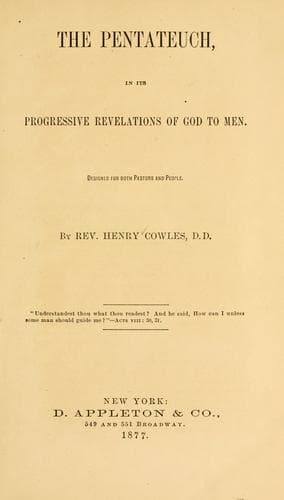
The Pentateuch, in Its Progressive Revelations of God to MenCowles, Henry
Religion
The Pentateuch, in Its Progressive Revelations of God to Men
Cowles, Henry
Bible. Pentateuch -- Criticism, interpretation, etc.
The third and last of the three great festivals was “the _Feast of
Tabernacles_,” otherwise called “the feast of ingathering at the end of
the year when thou hast gathered in thy labors out of the field” (Ex.
23: 16).――――The speciality of this feast was the dwelling in booths or
tabernacles, made of “boughs of goodly trees, branches of palm trees
and the boughs of thick trees and willows of the brook” (Lev. 23: 40).
This feast began on the fourteenth day of the seventh month and
continued during eight days, the first and the last being days of
special solemnity. It had a double purpose, viz. to commemorate the
forty years wandering of the fathers in the wilderness, dwelling in
tents; and to give thanks to God for the last harvests of the year――the
fruits of the olive and the grape――last in order――being now all
gathered in.
Thus none of these three great feasts omitted the element of
thanksgiving for the fruits of the season, the first barley sheaves
being brought with grateful thanks before the Lord during the Passover;
the first-fruits of the wheat harvest giving a special thanksgiving
character to the Feast of Pentecost; and the latest fruits, the olive
and the grape, reminding them of God’s crowning blessing upon the
labors of the year at the Feast of Tabernacles. What a beautiful
training into the service of thanksgiving for the fruits of the earth!
This last of the festivals was pre-eminently one of joyful festivity,
and of loud and high praises to the Lord, their Great Benefactor. The
Jews have a saying――that “whoever has not seen the rejoicing of the
last great day of the Feast of Tabernacles has never seen a day of joy
in his life.”
The principal passages of Moses that treat of it are Ex. 23: 16, and
34: 22, and Lev. 23: 34–43, and Num. 29: 12–40, and Deut. 16: 13–15.
The celebration of this feast in the age of Nehemiah (8: 14–18) the
reader should not fail to notice. At this time the law was read daily
in the hearing of the people. The law of Moses provided for this public
reading on each seventh, _i. e._ the Sabbatic year, during the Feast of
Tabernacles (Deut. 31: 10–13).
The striking allusion (Jn. 7: 37) to the scenes on the last great day
of the feast will be readily recalled. A custom unknown to the law of
Moses had then come into practice――that of going in vast procession to
the fountain of Siloam for water, and bearing it with joyful acclaim to
the temple to pour it out there before the Lord. While this procession
was passing, Jesus lifted up his voice and cried――“If any man thirst,
let him come unto me and drink.” May we suppose that possibly the words
of Isaiah were before him:――“Ho, every one that thirsteth, come ye to
the waters”――to these waters of life which I give for the life of the
world!
Public-domain text, read in full here on John Shaqi.
Reviews
Reviews
No reviews yet
Be the first to share your thoughts on this work.
Elsewhere in the archive
Join the Discussion
Join the discussion
Sign in to leave a comment or review.
Sign InorCreate an account