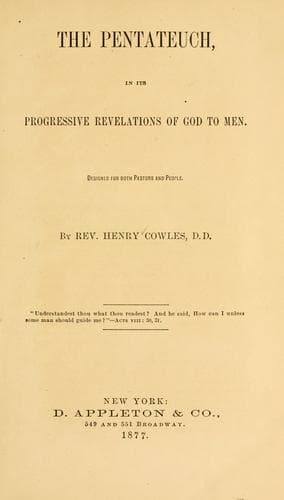
The Pentateuch, in Its Progressive Revelations of God to MenCowles, Henry
Religion
The Pentateuch, in Its Progressive Revelations of God to Men
Cowles, Henry
Bible. Pentateuch -- Criticism, interpretation, etc.
Upon these three great festivals all the males of Israel were
required to appear before the Lord at the one place of his choice――the
tabernacle or the temple――ultimately in Jerusalem “whither the tribes
go up.” The women of Israel manifestly went when they chose and
could. According to Oriental usage they traveled in groups――little
caravans――several adjacent families, or as the case might be by
households, the patriarch with his children and children’s children
together, moving on with many a song of social cheer and grateful
praise till at length they lifted up their eyes to the hills of the
goodly city. The so-called “songs of degrees” (Ps. 120–134)――more
strictly songs of the stages or upgoings――are specimens of this free
and outflowing worship of the traveling companies, bound upward to
Jerusalem. The allusion in Luke 2: 41–45, is pleasant to think of.
We must not overlook the fact that the Lord relieved their minds of
all fear lest their defenseless homes might be assailed and robbed and
perhaps their wives and little ones murdered by foreign enemies while
all their able-bodied men were away from their homes in Jerusalem.
“Neither shall any man desire thy land when thou shalt go up to appear
before the Lord thy God thrice in the year” (Ex. 34: 24). None but a
God of universal providence and omnipotent resources could safely make
such a promise. In their own Jehovah they might safely trust.
* * * * *
Of sacred seasons, the most peculiar and striking yet remains to be
noticed, viz. _the great day of atonement_. This was one day only; was
not a feast day but a _fast_――a day “in which ye shall _afflict your
souls_,” _i. e._ subject yourselves to the discomforts and pains of
entire abstinence from food for the whole day, “from even to even.”
Whoever would not afflict his soul on this day must be “cut off from
his people.” All labor was forbidden under the same penalty. The
passages Lev. 23: 26–32 and Num. 29: 7–11 give these general features
of the institution. Only in Lev. 16 do we find a full description.
In this chapter it appears that the original appointment of this day
stands connected with the sad death of Nadab and Abihu, the two eldest
sons of Aaron for their rash unauthorized offering of strange fire
before the Lord (Lev. 10: 1–8). That awful scene of death suggested
the great necessity of ceremonial purity in the priesthood and of the
utmost care and self-control when they came before God. There would be
sins in the priesthood and sins among the people of which they might
not be aware: hence the propriety of one comprehensive, all-embracing
service for atonement.
Public-domain text, read in full here on John Shaqi.
Reviews
Reviews
No reviews yet
Be the first to share your thoughts on this work.
Elsewhere in the archive
Join the Discussion
Join the discussion
Sign in to leave a comment or review.
Sign InorCreate an account