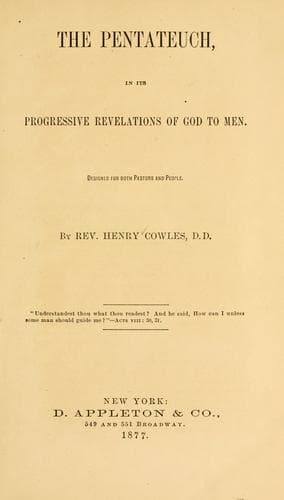
The Pentateuch, in Its Progressive Revelations of God to MenCowles, Henry
Religion
The Pentateuch, in Its Progressive Revelations of God to Men
Cowles, Henry
Bible. Pentateuch -- Criticism, interpretation, etc.
The points to be specially noted in this service are――That the High
Priest washed himself clean; put on white linen garments, symbolic of
purity, and then made a special offering for his own sins and for the
sin of all the people. The latter had this striking peculiarity――that
two goats were taken for a sin-offering, upon whom lots were cast to
select one for the Lord and one for Azazel [Eng. “scape-goat”]. Another
still more important peculiarity was that on this day only (never on
any other) the High Priest went alone into the most holy place, bearing
both the blood of the sin-offering and incense. First he bore into the
most holy place the blood of a bullock as a sin-offering for himself,
and sprinkled it with his finger upon the mercy-seat and in front
of the mercy-seat seven times. He also bore a censer full of coals
from the great altar and upon it burned incense, the smoke of which
enshrouded the mercy-seat. Then the goat upon which the lot fell for
the Lord was slain, and the High Priest bore his blood also into the
most holy place and sprinkled it there to make atonement for the whole
people. No other man save the High Priest might go in at any time on
pain of death.
The other goat, called in our English version “the scape-goat” was then
disposed of thus: Aaron “laid both his hands upon the head of this goat
and confessed over him all the iniquities of the children of Israel
and all their transgressions in all their sins, _putting them upon
the head of the goat_, and then sent him away by a fit man into the
wilderness――the goat bearing upon himself all their iniquities into a
land not inhabited.” He was then set at liberty in the wilderness (Lev.
16: 20–22).――――The precise meaning of the word Azazel [“scape-goat”]
and the reason for using this name have been much disputed. Our English
Bible fails to give a satisfactory translation of v. 8 where by a most
obvious antithesis the sacred lot selects one of the two goats for
Jehovah and the other for Azazel. Was it, as many suppose, for Satan,
conceived of as “walking through those dry and desolate places, seeking
rest but finding none”――to whom this goat, symbolically bearing the
sins of the whole people, is sent? If so, what is implied and signified
in this sending of the goat to him? I must say I am not wise on these
points. If any ideas were current in that age in respect to Satan
which might illustrate this transaction, they have not come down to
us. It must I think suffice for us to see in these two goats for a
sin-offering a sort of double figure to indicate the atonement――the
first one slain in the usual way and his blood sprinkled before the
mercy-seat――a solemn witness that without the shedding of blood there
can be no remission of sin: the other, supplementing the great idea of
atonement by a most vivid representation of _sins borne away_――forever
away, to be known and remembered no more. The sins of the whole people
Public-domain text, read in full here on John Shaqi.
Reviews
Reviews
No reviews yet
Be the first to share your thoughts on this work.
Elsewhere in the archive
Join the Discussion
Join the discussion
Sign in to leave a comment or review.
Sign InorCreate an account