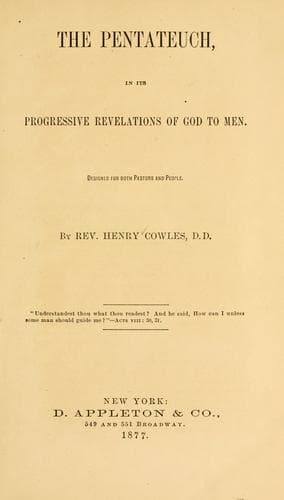
The Pentateuch, in Its Progressive Revelations of God to MenCowles, Henry
Religion
The Pentateuch, in Its Progressive Revelations of God to Men
Cowles, Henry
Bible. Pentateuch -- Criticism, interpretation, etc.
(5.) It is objected that the primary sense of the word bara[5] (used
here) is not to bring into existence what had no existence before,
but “to cut, to cut out, to carve” (Gesenius); “to cut, form, fashion”
(Fuerst). But this objection, though plausible to a merely superficial
view, is really of very little force. Usage, not etymological relation,
gives law to language. The etymological, primary sense of _barak_, the
common Hebrew word for _bless_, is to break; then to bend as the knee,
to kneel and to cause one to kneel; and then, perhaps from the custom
of kneeling to receive the patriarchal benediction, or to implore
blessings from God, comes the ultimate and by far the most common
significance――to bless. Usage in every case must determine the most
common and therefore most probable sense; then the context and the
known opinions of the writer come in to aid toward the true sense in
any given instance.
In the Hebrew verb regard must be had to its form, technically
called its “conjugation,” since the sense of the several conjugations
from the same root may vary widely. In this verb (bara) the sense of
Hiphil conjugation is to _fatten_――which is very remote from the sense
of “Kal” and of its passive “Niphal.” In Piel only do we find the
etymological sense to cut, to carve out (five times only) and these
spoken of human operations exclusively (Josh. 17: 15, 18 and Ezek.
23: 47 and 21: 19). But in Kal and its passive Niphal, we find the word
used forty-eight times, and _always of divine operations_――always of
some form of creative work wrought by God himself and never by man.[6]
The testimony therefore from usage is entirely conclusive to the point
that this word in this form of it was specially appropriated to signify
God’s creative acts――the exertion of his creative power.――――There are
two other Hebrew words having the sense to make, to form, [asah and
yatsar], which are sometimes used of God as creating but by far most
often of _man’s_ work in forming and molding material things. Now note
the argument. The Hebrews had these three words for _making_, out of
which one only is used exclusively of God――never of man――as a maker.
Now there is one special sense in which God can make and man can not,
viz. that of bringing into existence what had no existence before.
Over against this, place the fact that their word “bara” is used of
God’s making forty-eight times and of man’s making never, and we must
conclude that they expressed by this word that distinctive power of God
which man never can even approach――viz. the power to _give existence to
matter, to mind and to life_. In passages where this sense of “bara” is
appropriate, there can be no question that it is the real meaning.
5. _The relation of v. 1 to v. 2 and to the rest of the chapter._
Public-domain text, read in full here on John Shaqi.
Reviews
Reviews
No reviews yet
Be the first to share your thoughts on this work.
Join the Discussion
Join the discussion
Sign in to leave a comment or review.
Sign InorCreate an account