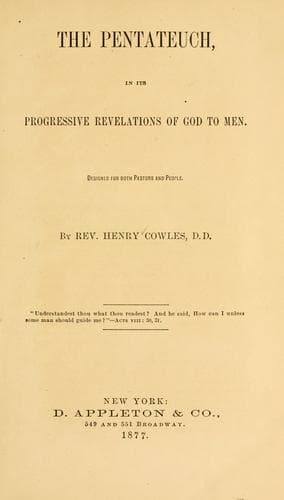
The Pentateuch, in Its Progressive Revelations of God to MenCowles, Henry
Religion
The Pentateuch, in Its Progressive Revelations of God to Men
Cowles, Henry
Bible. Pentateuch -- Criticism, interpretation, etc.
A system of worship which included altars and sacrifices, and much more,
one which had the ark of the covenant and the visible manifestation of
Jehovah’s presence, demanded an _edifice_ for its center and home. It
was essential to the proper reverence that this edifice should provide
a place of seclusion as well as of safe-keeping for its most sacred
things.――――Moreover, so long as the people were unsettled――subject
to removal any day――this structure must be movable, like the tents of
all nomadic people. Hence the first structure was the _Tabernacle_ or
_Sacred Tent_.――――A general idea of it may be presented to the reader
thus:――Conceive of an inclosed court, one hundred cubits long by fifty
wide [the cubit being eighteen inches]; this inclosure being made by
hanging curtains of linen five cubits high, suspended from horizontal
rods which were supported by posts. The entrance to this inclosure was
always at its eastern end, and the eastern section, forming the outer
or first court, was twenty cubits in depth, cut off from the rest of
the inclosed area by curtains.――――In the center of the rear portion
stood the sacred tent proper, thirty cubits in length from east to west,
and ten cubits in width. This also was in two principal apartments,
the eastern being twenty cubits by ten, known as “the holy place”;
the western, “the most holy place,” or the “Holy of holies,” being
ten cubits square. The perpendicular walls of this sacred tent were of
boards set on end, ten cubits high, so supported as to be readily set
up, taken down, and transported. The covering was four-fold, of cloth
and skins, and was manifestly arranged like the roof of a house, the
covering passing over a ridge-pole in the center. Such briefly was this
sacred structure.
Of its furniture, the important articles were as follows:
(a.) In the open court in front of the tabernacle proper, were the
great altar of burnt-offering and a laver――an immense reservoir or
tank for water. (b.) In the holy place――the first section of the sacred
tent――stood the altar of incense; the table of shew-bread; and the
golden candlestick.――――(c.) In the most holy place, enshrouded in the
thick darkness, stood the ark of the covenant, containing originally
the two tables of stone on which the ten commandments were written, the
pot of manna, and Aaron’s rod that budded. Upon the lid of this ark,
known as “the mercy-seat,” there reposed the refulgence of the Divine
Presence――a visible brightness and glory, called by the later Jews “the
shechinah”――itself overshadowed by the wings of cherubic figures which
rested upon either end of the ark.
The whole structure might be readily taken down and transported from
place to place with all its furniture; parties being designated for
this service.
Public-domain text, read in full here on John Shaqi.
Reviews
Reviews
No reviews yet
Be the first to share your thoughts on this work.
Elsewhere in the archive
Join the Discussion
Join the discussion
Sign in to leave a comment or review.
Sign InorCreate an account