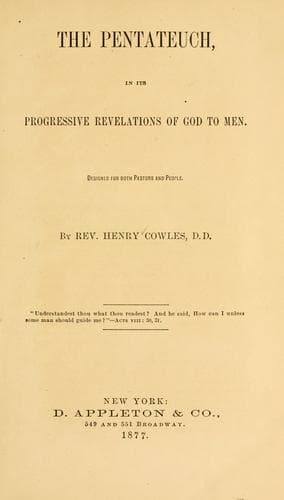
The Pentateuch, in Its Progressive Revelations of God to MenCowles, Henry
Religion
The Pentateuch, in Its Progressive Revelations of God to Men
Cowles, Henry
Bible. Pentateuch -- Criticism, interpretation, etc.
In Num. 10: 35, 36 we have the words customarily used by Moses as a
form of prayer, accompanying the order for striking and pitching tents:
“When the ark set forward Moses said, Rise up, Lord, and let thine
enemies be scattered, and let those that hate thee flee before thee:
and when it rested he said, Return, O Lord, unto the ten thousands of
Israel.”
Of the temple built by Solomon I need not say more than this――that
its plan was essentially that of the tabernacle, differing in the
following points: Its dimensions were twice as great; and it was built
for a permanent, immovable edifice, of the most substantial and costly
materials.
IV. _The Sacred Orders._
The tribe of Levi was chosen and set apart for the services of worship
and of religious instruction. Out of this tribe the family of Aaron was
selected for the priesthood. The most sacred services devolved upon the
priests, the High Priest only being permitted to enter the most holy
place once a year, as we have seen. The Levites performed subordinate
services, supplying the requisite wood and water for so vast a system
of sacrifices and offerings, and serving also in the transportation
of the sacred tent and its furniture. At a later period the service
of song in the house of the Lord was in their hands.
The law provided a full ritual for the induction of the High Priest
into his office and for the consecration of all the priests to their
work. Their robes of office, their various dress on all occasions,
are detailed with great minuteness.――――The law also provided specially
for their subsistence. A portion of various sacrifices fell to them
as their perquisite. The great expense of the entire ritual service,
including the cost of the animals offered for the people at large; the
support of the priests, and to some extent of the Levites, was provided
for by law in the tithes; the poll-tax of a half-shekel from every man
of Israel; and from various other sources.
In the ultimate settlement in Canaan, forty-eight cities with their
suburbs were given to the Levites. They were thus distributed among
the entire population of Canaan both east and west of the Jordan,
and if true to their mission would fill a very important sphere in
both the civil and the religious life of the nation. Of their civil
and judicial duties I have spoken already. They were also teachers of
religion.――――Their suburban territory would afford them a small amount
of land for cultivation; but the divine plan was that they who served
at the altar should live from the altar. While religious services were
conscientiously performed and the religious spirit was in due strength,
both priests and Levites would be comfortably fed and clad. Idolatry
and religious declension would cut their supplies short.
Public-domain text, read in full here on John Shaqi.
Reviews
Reviews
No reviews yet
Be the first to share your thoughts on this work.
Elsewhere in the archive
Join the Discussion
Join the discussion
Sign in to leave a comment or review.
Sign InorCreate an account