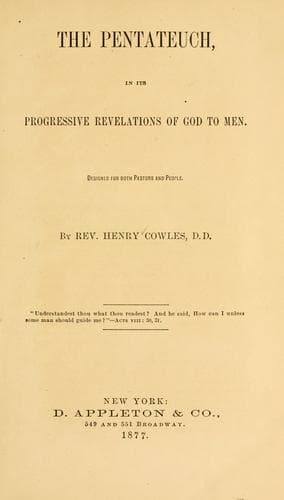
The Pentateuch, in Its Progressive Revelations of God to MenCowles, Henry
Religion
The Pentateuch, in Its Progressive Revelations of God to Men
Cowles, Henry
Bible. Pentateuch -- Criticism, interpretation, etc.
Thus with bands which no sophistry can sever, the Old Testament
and the New are bound together, and the atonement prefigured in the
former is embodied and made perfect in the latter. The almost ceaseless
blood-sheddings and blood-sprinklings of the former culminate in the
latter in the one great scene of death-agony and blood on Calvary.
The grand idea of expiatory suffering――of the vicarious death of the
innocent in place of the guilty, which ages of ceremonial sacrifice
had been setting forth and working into the minds of all reverent
worshipers, had prepared the way for Christ’s disciples to understand
the mystery of his bloody death and to teach the Christian world in
the writings of the New Testament _how_ the blood of Jesus “_takes away
sin_.”
* * * * *
In closing our notice of this religious system, let us revert for
a moment to the fact that all its important features were so many
important _steps of progress_ in the manifestation of God to man. These
were lessons in advance of all that had preceded on that greatest of
all questions――How shall man approach his Maker, and how shall he offer
acceptable worship?――――That God deigned to come down and dwell with
his obedient people is the precious truth which underlies all these
provisions for his worship. How shall man treat this Heavenly Guest;
how adjust himself to this pure and majestic Presence; with what
state of heart; with what purity and cleanliness of person; with
what offerings and sacrifices and of what significance?――――These are
the points embraced in these great lessons taught in this religious
system. The perpetual inculcation of cleanliness and of conscientious,
scrupulous care; the practice of perpetual thanksgiving; but above all,
the copious illustrations of the great idea of bloody sacrifice to take
away sin;――these have been already named as the salient features in
this system, and all (it will be noticed) are _points of progress_.
Bloody sacrifices and altars appear in the worship offered by Abraham,
Noah, and even Abel. But how much more fully is their true import
unfolded here? Here is confession of sin on the part of the worshiper;
here is the symbolic transfer of sins by imposition of hands upon
the head of the victim brought out to die: here is the sprinkling
of his blood all round about the altar; upon the very mercy-seat
and immediately in the presence of the Holy One who sat beneath the
cherubim; upon the worshipers also gathered round the bloody altar:
here are the special solemnities of the great day of atonement in
which the whole sacrificial system culminated――all combining their
significance to unfold the great idea of the vicarious sufferings of
an innocent victim in place of guilty men.
CHAPTER XX.
HISTORIC EVENTS OF HEBREW HISTORY FROM SINAI TO THE JORDAN.
_The Golden Calf._
Public-domain text, read in full here on John Shaqi.
Reviews
Reviews
No reviews yet
Be the first to share your thoughts on this work.
Elsewhere in the archive
Join the Discussion
Join the discussion
Sign in to leave a comment or review.
Sign InorCreate an account