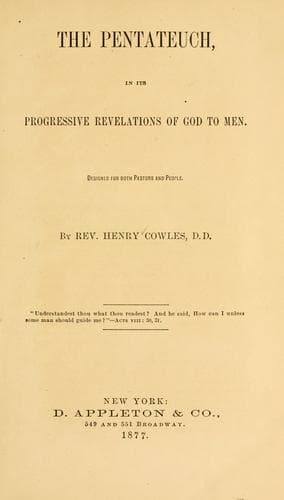
The Pentateuch, in Its Progressive Revelations of God to MenCowles, Henry
Religion
The Pentateuch, in Its Progressive Revelations of God to Men
Cowles, Henry
Bible. Pentateuch -- Criticism, interpretation, etc.
pre-intimated by the bloody offerings enjoined in this Hebrew system?
Argumentatively, it would seem that these great questions are decided
forever by the following considerations:
1. If the bloody sacrifices of this ancient system do not set forth the
atoning death of Christ, they mean nothing; this, or nothing at all.
2. The writer to the Hebrew Christians testifies that they mean this.
To give the proof of this statement in full would repeat entire the
seventh, eighth, ninth, and tenth chapters of this epistle. It would be
idle to say that this writer does not refer to the sacrificial system
of ancient Israel; equally idle to claim that he does not speak of the
bloody death of Christ; more than idle to deny that in his view that
old system sought to illustrate this new one――those bloody scenes were
foreshadowing pre-intimations of Christ’s death; that those priests
were precursors of this greater High Priest; that the blood which
Aaron bore once a year into the most holy place meant neither more nor
less than that Jesus was in his time to enter once for all into a yet
more holy place with his own blood and thus achieve for us eternal
redemption. Jesus “needed not daily as did those priests to offer
sacrifice, first for his own sins and then for the people’s; for this
he did once” [for all] “when he offered up himself” (Heb. 7: 27).
3. All the New Testament writers were Jews; men of Jewish education,
men of life-long training in religious ideas based on this Hebrew
sacrificial system. They never speak of the purpose or results of
Christ’s death save in terms and phrases taken from this system given
through Moses. Jesus never speaks of his own death save in these
same words and phrases. When he speaks of “giving his life a ransom
for many” (Mat. 20: 28); when he said, “This is my blood of the New
Testament which is shed for many for the remission of sins” (Mat.
26: 28); when his great forerunner speaks of him as “the Lamb of God
who taketh away the sin of the world” (Jno. 1: 29);――or Peter (1 Eps.
2: 24) as “bearing our sins in his own body on the tree;” or Paul
(2 Cor. 5: 21) as being “made a sin-offering for us that we might
be made the righteousness of God in him,” it is simply impossible
to disprove the reference of these terms and phrases to the Mosaic
system――impossible to give them any other sense than that which
is illustrated in the bloody death of the sin-offerings and
burnt-offerings of that ancient law.
Public-domain text, read in full here on John Shaqi.
Reviews
Reviews
No reviews yet
Be the first to share your thoughts on this work.
Elsewhere in the archive
Join the Discussion
Join the discussion
Sign in to leave a comment or review.
Sign InorCreate an account