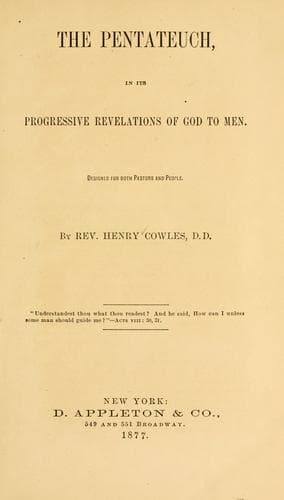
The Pentateuch, in Its Progressive Revelations of God to MenCowles, Henry
Religion
The Pentateuch, in Its Progressive Revelations of God to Men
Cowles, Henry
Bible. Pentateuch -- Criticism, interpretation, etc.
CREATION, p. 9.
Naturally the first fact revealed; Its moral lessons, 9;
The origin of this record and the manner of its revelation to
men, 12;
Nature and the supernatural, 13;
Theories on the origin of life, 14;
The sense of the word “day” in Gen. 1: 16; Argued
(1) From the laws of language, 17;
(2) From the narrative itself, 18;
Objection from the law of the Sabbath, 21;
(3) From Geological facts and their bearings on the question,
22;
Prominent points of harmony between Genesis and Geology,
25;
(4) Does “Create” (Gen. 1: 1) refer to the original production
of matter? 26;
(5) The relation of v. 1 to v. 2, and to the rest of the
chapter, 29;
(6) The work of the fourth day, 31;
(7) The sense of the record as to the _origin of life_,
vegetable and animal, 32;
(8) On God’s “making man in his own image,” 33;
(9) The relation of Gen. 2: 4–25 to Gen. 1, 35;
(10) Invariability of “_kind_” in the vegetable and animal
kingdoms, 37;
The theory of Mr. Darwin, 38;
The issue between Darwin and Moses, 38;
Darwin’s five main arguments, 39;
Brief replies, 40;
Objections bearing generally against Darwin’s scheme, 43;
(1) It requires almost infinite time back of the
earliest traces or possibilities of life, 43;
(2) Requires what Nature does not give――a close
succession of animal races, differing but
infinitesimally from each other, 43;
(3) His argument is essentially _materialistic_ and is
therefore false, 45;
(4) It ignores man’s intellectual and moral nature, 46;
(5) It ignores or overrides the law of nature by which
hybrids are infertile, 46;
(6) This scheme is in many points revolting to the
common sense of mankind, 46;
(7) It is ♦reckless of the authority of revelation, 48.
CHAPTER II.
THE ANTIQUITY OF MAN, 49;
Two main questions:
1. Is the human family older than Adam? 49;
(1) The argument for man’s high antiquity,
From traces of his skeleton, 50;
From his tools and works, 51;
(2) From the traditions and chronologies of the old
nations, 59.
CHAPTER III.
HEBREW CHRONOLOGY, 60;
2. How far back was Adam? 60;
From birth of Christ back to the founding of Solomon’s
Temple, 60;
First disputed period――that of the Judges, 60;
Second disputed period――that of the sojourn in Egypt, 62;
Third disputed period――between Terah and Abraham, 64;
Fourth disputed period――from the creation to the flood, 66;
Fifth disputed period――from the flood to the call of
Abraham, 68.
Public-domain text, read in full here on John Shaqi.
Reviews
Reviews
No reviews yet
Be the first to share your thoughts on this work.
Join the Discussion
Join the discussion
Sign in to leave a comment or review.
Sign InorCreate an account