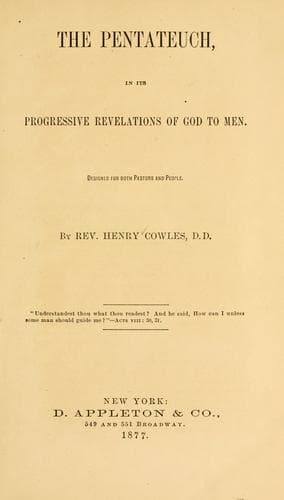
The Pentateuch, in Its Progressive Revelations of God to MenCowles, Henry
Religion
The Pentateuch, in Its Progressive Revelations of God to Men
Cowles, Henry
Bible. Pentateuch -- Criticism, interpretation, etc.
Some scientific men suppose they find in this second verse, not
water, but the gaseous matter which ultimately became water and
solid earth. This construction originates in a theory in regard
to the primal form in which the matter of our world came from the
Creator’s hand, which theory may or may not be true, but if true is
too remote from the common mind and too foreign from the scope of
divine revelation to allow us to suppose that God would refer to it
in his revelation.――――Carrying out this scientific theory, some have
held[7] that not only the “waters” of v. 2 but those of vs. 6, 7,
were gases, not waters. The fatal objections to this theory are――that
these “waters” are the same which in vs. 9, 10, are “gathered into
one place” and “called seas;” also that the common people for several
thousand years could not have understood Moses if he had spoken of
gases――certainly could not have understood their common word for
waters to mean gases.――――It is not well to strain and force this simple
narrative to speak so scientifically as to be unintelligible to those
for whom it was primarily written.――――The first state of created matter
may have been gaseous. The record in Genesis has said nothing to forbid
this. It certainly could not come within its province to teach it.
Suffice it that time enough may be found between verses 1 and 2 for a
portion of this gaseous matter to form water――not to say also to form
the more solid portions of this globe.
The connection of v. 2 with v. 1 is such that an indefinitely long
period may have intervened. The first verb of v. 2 implies no close
connection with v. 1. But in v. 3 the form of the first verb――“And
_then_ God said”――does make a close historical connection with v. 2.
6. The work of the fourth day. Were the light-bearers (“lights” in the
sense of luminaries) in the heavens, viz. the sun, moon, and stars also,
“made,” created, on this day, or simply brought forth to the view of a
supposed observer upon the earth?――――The latter theory that they were
not first brought into being then, but only brought into view from the
earth――seems to me most probable, because――(1.) To suppose them created
then would be out of all proportion for one day’s work among the six.
Throughout the other five days’ work a beautiful proportion obtains:
it should therefore be expected in this.――――If it be said that this
consideration draws its great strength from our astronomical knowledge
of those heavenly bodies――much more enlarged than those of the age
of Moses, I answer (a.) Moses, “learned in all the wisdom of the
Egyptians,” was not altogether a novice in astronomy――(b.) Modern
astronomy is essentially true, not overrating the relative magnitude
of the heavenly bodies; and this record in Genesis comes from one who
knew all the truth.
Public-domain text, read in full here on John Shaqi.
Reviews
Reviews
No reviews yet
Be the first to share your thoughts on this work.
Join the Discussion
Join the discussion
Sign in to leave a comment or review.
Sign InorCreate an account