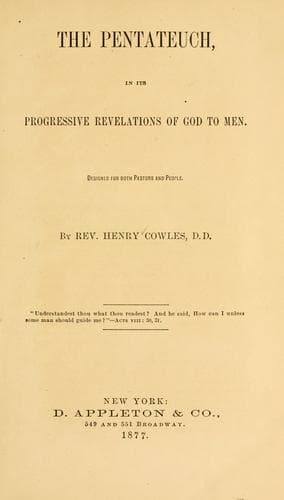
The Pentateuch, in Its Progressive Revelations of God to MenCowles, Henry
Religion
The Pentateuch, in Its Progressive Revelations of God to Men
Cowles, Henry
Bible. Pentateuch -- Criticism, interpretation, etc.
1. To Darwin’s first law, viz. that the offspring always vary though
slightly from the parent, and therefore, given indefinite time, he has
any desired amount of variation, I reply that this law of variation
becomes practically worthless for his theory, because these variations
from parent to offspring run in all conceivable directions and not in
the one definite direction required for his purpose, _i. e._ toward a
higher grade of perfection, or [which his argument requires] toward a
new form of animal life. For example, there is always some change in
the human countenance from parent to child. Yet who does not know that
those changes run in every possible direction and not in one uniform
line of progress or advance, as from monkey toward man and from man
toward angel? For another example we may take the shape of the skull
and of the brain――evermore differing slightly from parent to offspring
yet not by any means on one given line. The skulls of Egyptian mummies
entombed three thousand years ago do not differ appreciably from those
of the Copts (their lineal descendants) of to-day, _i. e._ are no more
pithecoid――ape-like. On Darwin’s theory three thousand years backward
ought surely to approximate toward the ape; otherwise these variations
are fruitless. This law of successive genealogical changes amounts
to nothing for his argument unless the changes consent to _come into
line_ so that their results shall actually _accumulate_ with the lapse
of ages. The fatal lack in the argument is――no husbandry of these
infinitesimal changes――not the least perceivable accumulation.
A second branch of my reply suggests that Mr. Darwin _misinterprets
this law of nature_, viz. perpetual variation from parent to offspring.
It is doubtless a law, but Darwin has quite missed its divinely
ordained purpose――which is to indicate the relationship between parent
and child on the one hand, and yet maintain individual identity on
the other. The resemblances answer the former purpose; the differences,
the latter. Beings constituted to bear personal responsibilities so
momentous as those of man must be so organized that every one can
identify his own individuality, lest one man be hung for some other
man’s crime.
Public-domain text, read in full here on John Shaqi.
Reviews
Reviews
No reviews yet
Be the first to share your thoughts on this work.
Join the Discussion
Join the discussion
Sign in to leave a comment or review.
Sign InorCreate an account