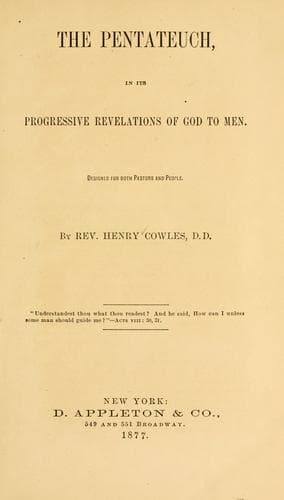
The Pentateuch, in Its Progressive Revelations of God to MenCowles, Henry
Religion
The Pentateuch, in Its Progressive Revelations of God to Men
Cowles, Henry
Bible. Pentateuch -- Criticism, interpretation, etc.
This approximates toward harmony with the reported results of the
Indian chronology which locates the creation B. C. 6174; also the
♦Babylonian, B. C. 6158, and the Chinese, B. C. 6157――the excess of
the latter above the longest sacred chronology being only 530 years.
The approach toward harmony in these three not sacred chronologies――the
Indian, the ♦Babylonian and the Chinese――the extreme difference being
only 17 years――is certainly a remarkable fact.
CHAPTER IV.
THE ANTIQUITY OF MAN RESUMED.
AS to the antiquity of Egyptian art, civilization and political power,
there are two main questions:
1. _How much time, after Noah, is required?_
2. _How much can be allowed in harmony with the most reliable
authorities of Hebrew chronology?_
1. Under the head of _time required_, it is in place to note the
circumstances which favored the very rapid growth of Egyptian
civilization and also of the numerical and political power of Egypt.
(a) Mizraim, the father of Egypt, who gave his name to the kingdom, was
a grandson of Noah and the father of seven sons (Gen. 10: 1, 6, 13, 14).
Consequently he started _early and strong_.
(b) The fertility of the Nile valley was prodigious; it was capable,
therefore, of sustaining an immense population, and so would attract
other people besides the lineal descendants of Mizraim. Every thing was
propitious for the early and rapid peopling of their country.
(c) Fixed residence, coupled with cheap bread and abundance of it, put
the Egyptian on vantage-ground above any other ancient nation for the
early culture of art and for rapid growth in all that made Egypt great.
(d) It is a capital mistake to assume that the arts and sciences _were
originated_ in Egypt after the flood, and that therefore a very long
time must be allowed for their growth and development up from utter
barbarism. For there was surely no insignificant amount of art and
science among the builders of Noah’s ark. The yet earlier history of
the race names “the father of all such as handle the harp and organ,”
and also “an instructor of every artificer in brass and iron” (Gen.
4: 21, 22).
(e) It is a significant fact that the Chaldean tradition of the deluge
as preserved by Berosus sets forth the special care taken by Noah to
preserve and transmit to the new-born nations after the flood the arts
and sciences which had been developed before that catastrophe. They
say he was admonished to put in writing an account of these arts and
sciences and deposit it in a place of safety until the flood should
be past. This tradition reveals the fact of a current belief that
there was such knowledge to be preserved, and that means were used to
preserve it.
Public-domain text, read in full here on John Shaqi.
Reviews
Reviews
No reviews yet
Be the first to share your thoughts on this work.
Elsewhere in the archive
Join the Discussion
Join the discussion
Sign in to leave a comment or review.
Sign InorCreate an account