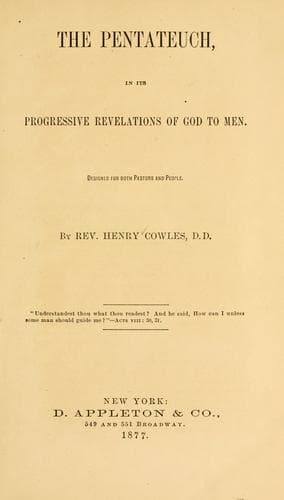
The Pentateuch, in Its Progressive Revelations of God to MenCowles, Henry
Religion
The Pentateuch, in Its Progressive Revelations of God to Men
Cowles, Henry
Bible. Pentateuch -- Criticism, interpretation, etc.
(g.) In table A it will be readily seen, comparing the figures of
the first column in the Hebrew with the corresponding figures in the
Septuagint, that the latter are very uniform while in the Hebrew there
is a wide diversity between the highest and the lowest, four standing
considerably below 100 and two above 180. The probability seems to be
somewhat against so wide diversity.――――In table B the Hebrew figures
in the first column are sufficiently near each other. Out of seven in
succession the extremes are 29 and 35. We have an equal uniformity in
the first column of the Septuagint and of the Samaritan, six of these
figures being the same as in the Hebrew with only the addition of 100.
The Hebrew figures seem low relatively to the total years; and on the
other hand the Septuagint figures seem too high. Especially is this
objection formidable when we remember Abram’s surprise that God should
promise him a son when 100 years old (Gen. 17: 17). “Shall a child be
born to him that is 100 years old?”――as if it were a thing unknown in
then recent history. But if all Abram’s ancestors back to the flood
begat their respective sons in this line at ages ranging from 135 to
130 (or all but Terah) it is somewhat difficult to account for his
surprise. The best we could say would be that the average human life
was fast lessening. I regard this as the most serious objection of
internal character against the integrity of the Septuagint text.――――On
the whole the chronological questions at issue between the Hebrew text
and the Septuagint, turning upon the authority of their respective
texts, are very much complicated and not a little doubtful. I have laid
before the reader what I regard as the main arguments, and rest the
case here, hopeful that greater light may yet arise, leaning, however,
toward accepting the authority of the Septuagint.
* * * * *
Reviewing the points made in this examination of Hebrew chronology,
it will be seen that we extend the time beyond Usher’s system,
(a.) In the period of the Judges at least 111 years; (b.) In the
sojourn in Egypt 215 years; and (omitting the interval between Terah
and Abram as uncertain), (c.) In the interval from the flood to the
call of Abram (if the Septuagint be followed) at least 650 years, and
perhaps 750; and (d.) In the period from the creation to the flood, 606
years――a total of 1582 or 1682 years.――――Or, to put the case in another
form, we put the Exodus in the year (B. C.) 1603; Jacob’s going into
Egypt, B. C. 2033; the call of Abram, B. C. 2248; and by the Septuagint
the flood, 3265 or 3365; and finally, by the Septuagint, the creation,
B. C. 5527 or 5627.
Public-domain text, read in full here on John Shaqi.
Reviews
Reviews
No reviews yet
Be the first to share your thoughts on this work.
Elsewhere in the archive
Join the Discussion
Join the discussion
Sign in to leave a comment or review.
Sign InorCreate an account