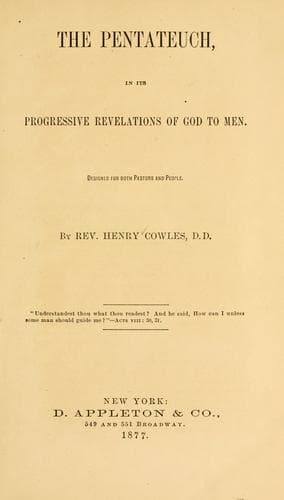
The Pentateuch, in Its Progressive Revelations of God to MenCowles, Henry
Religion
The Pentateuch, in Its Progressive Revelations of God to Men
Cowles, Henry
Bible. Pentateuch -- Criticism, interpretation, etc.
III. _The Temptation._
On this point the history is remarkably full and distinct. To those who
have given attention to what may be called _the law of temptation_――the
way it works and gains its object――little explanation of the narrative
is needed.――――We may note that Satan took care not to be recognized as
an enemy; that he made his first approaches with subtlest caution and
skill, bringing up the case of the prohibited fruit as a question――Is
it _indeed so_ that God hath said, Ye shall not eat of every tree? As
if he would say――What do you think about this prohibition? Is it quite
pleasant to be put under such restraint?――――When Eve recited the words
of God’s prohibition and added something more――viz. “neither shall
ye touch it,” it is at least supposable that Satan had already sprung
in her mind the feeling that the injunction was indeed very stringent,
perhaps unreasonably and unkindly so. It is plain that Satan is
emboldened and now ventures to strike out squarely against God. Putting
his word unqualifiedly against God’s word, “ye shall _not_ surely die,”
he became “the father of lies,” “a liar from the beginning,” and threw
all the weight of his influence into the scale to break down Eve’s
confidence in God’s veracity as well as in his real kindness. Then with
Satanic cunning he took advantage of the name given to this forbidden
tree to make Eve think that knowledge, great and enviable like that of
the gods, would come from eating this fruit. Artfully he charges that
God knew this, and sought by the prohibition to debar them from this
boon of knowledge so desirable. The gilded bait was swallowed but too
soon and too thoughtlessly! Eve had listened; she had more than half
believed these lies; she still dallied with the temptation; she looked
again at the tree and its fruit; she saw it beautiful and seemingly
good for food; and, far beyond this, it appealed to her imagination
as giving her that unknown wisdom, like the wisdom of the gods――so she
took of it and _ate_!――――Then she brought of it to her husband. Her
words to him are not on record. We are left to imagine how her example
may have wrought upon him, and sympathy also with her doom if Adam
thought of that; how the feeling――I must stand or fall, live or die,
with this only human friend I have on earth――may have overcome every
scruple. So far as appears he yielded without a word of question, much
less of reproof. He yielded――and the awful deed was done!
IV. _The Fall and its Immediate Effects._
Public-domain text, read in full here on John Shaqi.
Reviews
Reviews
No reviews yet
Be the first to share your thoughts on this work.
Elsewhere in the archive
Join the Discussion
Join the discussion
Sign in to leave a comment or review.
Sign InorCreate an account