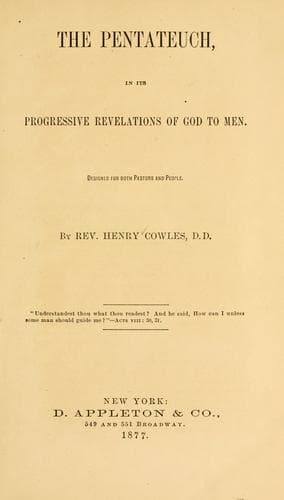
The Pentateuch, in Its Progressive Revelations of God to MenCowles, Henry
Religion
The Pentateuch, in Its Progressive Revelations of God to Men
Cowles, Henry
Bible. Pentateuch -- Criticism, interpretation, etc.
In what sense was this called, “The tree of the knowledge of good and
evil”? (Gen. 2: 9, 17 and 3: 5)――――It brought the knowledge of evil by
fearful experience; the knowledge of good to a certain extent by the
freshened sense of contrast with the experience of evil. Sin gives to
moral beings _such_ knowledge of good and of evil――knowledge it were
better far for them they should never have!
_Was the fruit of this tree a natural poison?_ We do not know. God
has not told us. It may have been or it may not. God does not base his
prohibition on this ground. There are other grounds, all-sufficient,
without this. It might perhaps be urged with some plausibility that the
analogy of this earthly life favors the affirmative inasmuch as for the
most part, God’s prohibitions of food and indeed of animal indulgence
in general, are based on this principle――Abstain from poison; do
thyself no harm. God is not wont to prohibit aught that is good for
food or pleasurable to any sense, except because it is pernicious,
poisonous.
What was this threatened penalty? _Death, in what sense?_
In the same sense in which it actually falls upon all who reject
Christ and fail of his salvation. Upon such the curse of the law falls
without abatement or modification. Their doom must surely be taken
as the exponent and measure of the meaning of this threatened death.
Of course it includes the loss of God’s favor; the incurring of his
frown.――――That eternal death did not begin instantly was due to arrest
of judgment for a new probation under the scheme of redemption; and to
nothing else.
_Was natural death a part of this penalty?_――――Plainly natural death
became the doom of the race, equally of the redeemed and of the
unredeemed, under the scheme of redemption――a scheme which carried with
it more or less of earthly life before the death of the body. But this
proves nothing as to the breadth of the original threatening――“Thou
shalt surely die.” What would have been in respect to natural death
if no scheme of redemption had intervened and the original threatening
had been executed at once, we have no means of knowing. Mortality as at
present resting on the race and terminating in natural death is one of
the incidents of the new probation under mercy, and gives us no light
on the other question, viz. What if no mercy had come in? In general,
it is of small account for us to ask, What would have been if something
else had happened otherwise than it did? _e. g._ What would have taken
place if the first pair had endured all temptation? How long would the
trial have continued? Would it have terminated by removing the tree,
or by taking off the prohibition, or only by such complete victory
over temptation that its presence could have been only a joy and a
triumph?――――What part would have been borne by “the tree of life”? And
after their sin, what if they had put forth their hand to take and eat
of this life-tree?――――Speculations of this sort never make men wiser.
Public-domain text, read in full here on John Shaqi.
Reviews
Reviews
No reviews yet
Be the first to share your thoughts on this work.
Elsewhere in the archive
Join the Discussion
Join the discussion
Sign in to leave a comment or review.
Sign InorCreate an account