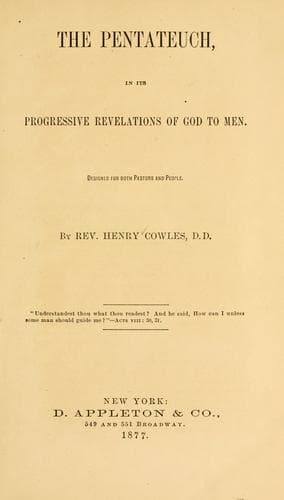
The Pentateuch, in Its Progressive Revelations of God to MenCowles, Henry
Religion
The Pentateuch, in Its Progressive Revelations of God to Men
Cowles, Henry
Bible. Pentateuch -- Criticism, interpretation, etc.
We have some rays of light on this point from the writer to the
Hebrews who says: “_By faith_ Abel offered unto God a more excellent
sacrifice than Cain, by which he obtained witness that he was righteous,
God testifying of his gifts.” Now the simplest idea of faith, the
one element always present in it, is _bowing to God’s authority with
implicit confidence in his word_. But in this case bowing to God’s
authority implies that God had given some word in reference to bloody
sacrifices――the offering of a lamb by shedding its blood upon the altar.
And if God had given any such word of command, it is certainly to be
presumed that he had also given at least this general idea, that the
blood of the innocent lamb took, in some sense, the place of the blood
of the guilty offerer, so that the sacrifice would imply the confession
of guilt, and also faith in a bloody substitute of the Lord’s own
providing.――――Prosecuting our investigations we find this broad fact
of history bearing on the case, viz. that Noah, Abraham and Isaac
built altars wherever they were sojourning and offered bloody
sacrifices thereon. Further, God directed Noah to preserve in the ark
clean animals by sevens, but animals not clean only in pairs――two of
a species――a fact which can not be reasonably accounted for save with
reference to their customary use in sacrifice. We have then before
us the well-established fact of the early custom of bloody animal
sacrifices.
* * * * *
_How came this custom into existence?_
It did not originate _with men_――certainly not with _good men_. Apart
from divine suggestion, they could not have supposed that the slaughter
of an innocent animal would be pleasing to God. The presumption would
be utterly against this. They could not have thought out the divine
idea of atonement for sin by the death of Christ, God’s own incarnate
Son: the very supposition is absurd, for it supposes that men were
able to sound the infinite depths of God’s wisdom and of his love,
and to grasp the relations and bearings of his vast moral government
with a reach of thought, not human but divine. Yet further; it is
not supposable that, having excogitated and discovered the grand idea
of atonement, they could have devised the plan of prefiguring this
atonement by the bloody sacrifice of the most innocent, harmless
and lovely of the animal races.――――And further, if they could have
thought out this miracle of God’s wisdom and love――both the divine
idea of atonement, and the expediency of illustrating it for ages by a
foreshadowing system of bloody sacrifices――it would still have been the
height of presumption in them to have started this system of sacrifices
without God’s special and sanctioning appointment.
Public-domain text, read in full here on John Shaqi.
Reviews
Reviews
No reviews yet
Be the first to share your thoughts on this work.
Elsewhere in the archive
Join the Discussion
Join the discussion
Sign in to leave a comment or review.
Sign InorCreate an account