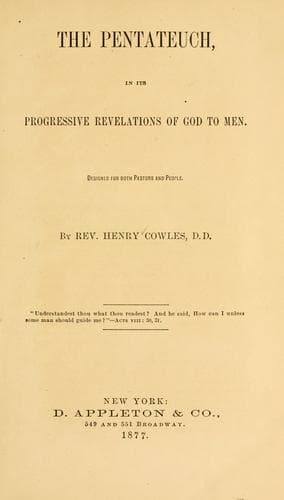
The Pentateuch, in Its Progressive Revelations of God to MenCowles, Henry
Religion
The Pentateuch, in Its Progressive Revelations of God to Men
Cowles, Henry
Bible. Pentateuch -- Criticism, interpretation, etc.
We are therefore shut up to this alternative: Either the whole system
of altars and bloody sacrifices, as practiced by Abel, Noah, Abraham
and Isaac, was an unmeaning farce――a thing of no significance, a mere
amusement or fancy, meaning nothing and good for nothing; or, God
himself originated the system and enjoined it, and these good men
were observing it in obedience to special revelation from God.――――Here
it will be readily seen that the first side of this alternative is
perfectly precluded by the fact that God approved their sacrifices. God
“had respect to the offering of Abel.” He “smelled a sweet savor” in
the sacrifices offered by Noah (Gen. 8: 20, 21.) The other alternative
therefore, viz. that bloody sacrifices originated in a direct
revelation from God――is the only supposition left us. We must adopt it.
It can not be necessary to draw out an argument to prove that in
instituting this system of bloody sacrifices God gave his people some
notion of its significance. The whole record shows that he was on most
familiar terms with them and therefore can not be supposed to have left
a point of so much importance utterly blank. It is not too much to say
that unless some light were thrown by the Lord himself upon the meaning
and purpose of these bloody offerings, the command to make them would
require some apology; for apart from their expiatory significance,
they are most revolting to even human benevolence――most foreign to all
just notions of what is due treatment of innocent lambs, bullocks and
doves from our hand. It should also be considered that their moral
value depends on their significance. All these bloody sacrifices must
have been practically valueless unless their expiatory significance
was in some good degree understood. That God ordained them for the sake
of their moral value, who can for a moment doubt?――――The conclusion,
therefore, seems inevitable that God not only enjoined these bloody
sacrifices, but gave his people to understand in general their
significance to the extent of fulfilling that unconscious prophecy of
Abraham (Gen. 22: 8): “My son, God will provide for himself a lamb for
a burnt-offering.”
These views, if just, are of vast historic value as showing _how much_
God taught his people at that earliest day, pertaining to his great
thoughts of redemption for a lost race.
* * * * *
3. _The great moral lessons of the antediluvian age._
Public-domain text, read in full here on John Shaqi.
Reviews
Reviews
No reviews yet
Be the first to share your thoughts on this work.
Elsewhere in the archive
Join the Discussion
Join the discussion
Sign in to leave a comment or review.
Sign InorCreate an account