London (England) -- Social conditions; Poor -- England -- London
[Illustration]
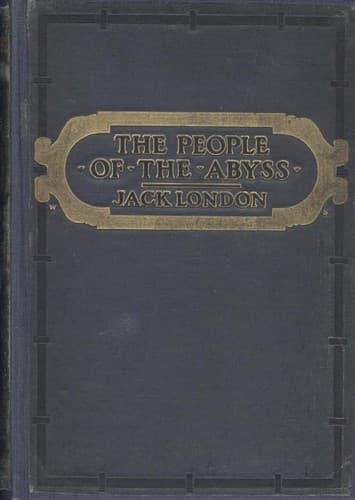
The People of the Abyss
by Jack London
Contents
PREFACE
I. THE DESCENT
II. JOHNNY UPRIGHT
III. MY LODGING AND SOME OTHERS
IV. A MAN AND THE ABYSS
V. THOSE ON THE EDGE
VI. FRYING-PAN ALLEY AND A GLIMPSE OF INFERNO
VII. A WINNER OF THE VICTORIA CROSS
VIII. THE CARTER AND THE CARPENTER
IX. THE SPIKE
X. CARRYING THE BANNER
XI. THE PEG
XII. CORONATION DAY
XIII. DAN CULLEN, DOCKER
XIV. HOPS AND HOPPERS
XV. THE SEA WIFE
XVI. PROPERTY VERSUS PERSON
XVII. INEFFICIENCY
XVIII. WAGES
XIX. THE GHETTO
XX. COFFEE-HOUSES AND DOSS-HOUSES
XXI. THE PRECARIOUSNESS OF LIFE
XXII. SUICIDE
XXIII. THE CHILDREN
XXIV. A VISION OF THE NIGHT
XXV. THE HUNGER WAIL
XXVI. DRINK, TEMPERANCE, AND THRIFT
XXVII. THE MANAGEMENT
The chief priests and rulers cry:—
“O Lord and Master, not ours the guilt,
We build but as our fathers built;
Behold thine images how they stand
Sovereign and sole through all our land.
“Our task is hard—with sword and flame,
To hold thine earth forever the same,
And with sharp crooks of steel to keep,
Still as thou leftest them, thy sheep.”
Then Christ sought out an artisan,
A low-browed, stunted, haggard man,
And a motherless girl whose fingers thin
Crushed from her faintly want and sin.
These set he in the midst of them,
And as they drew back their garment hem
For fear of defilement, “Lo, here,” said he,
“The images ye have made of me.”
JAMES RUSSELL LOWELL.
PREFACE
The experiences related in this volume fell to me in the summer of
1902. I went down into the under-world of London with an attitude of
mind which I may best liken to that of the explorer. I was open to be
convinced by the evidence of my eyes, rather than by the teachings of
those who had not seen, or by the words of those who had seen and gone
before. Further, I took with me certain simple criteria with which to
measure the life of the under-world. That which made for more life, for
physical and spiritual health, was good; that which made for less life,
which hurt, and dwarfed, and distorted life, was bad.
It will be readily apparent to the reader that I saw much that was bad.
Yet it must not be forgotten that the time of which I write was
considered “good times” in England. The starvation and lack of shelter
I encountered constituted a chronic condition of misery which is never
wiped out, even in the periods of greatest prosperity.
Following the summer in question came a hard winter. Great numbers of
the unemployed formed into processions, as many as a dozen at a time,
and daily marched through the streets of London crying for bread. Mr.
Justin McCarthy, writing in the month of January 1903, to the New York
_Independent_, briefly epitomises the situation as follows:—
Public-domain text, read in full here on John Shaqi.
Reviews
Reviews
No reviews yet
Be the first to share your thoughts on this work.
Join the Discussion
Join the discussion
Sign in to leave a comment or review.
Sign InorCreate an account