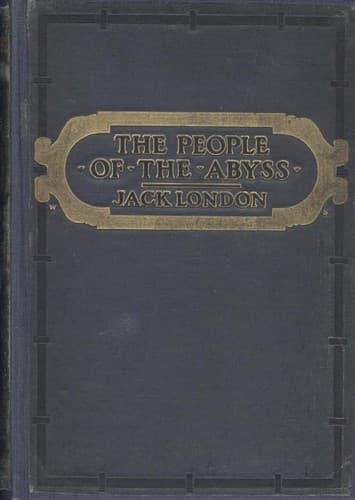
London (England) -- Social conditions; Poor -- England -- London
Not only did the houses I investigated have no bath-tubs, but I learned
that there were no bath-tubs in all the thousands of houses I had seen.
Under the circumstances, with my wife and babies and a couple of
lodgers suffering from the too great spaciousness of one room, taking a
bath in a tin wash-basin would be an unfeasible undertaking. But, it
seems, the compensation comes in with the saving of soap, so all’s
well, and God’s still in heaven.
However, I rented no rooms, but returned to my own Johnny Upright’s
street. What with my wife, and babies, and lodgers, and the various
cubby-holes into which I had fitted them, my mind’s eye had become
narrow-angled, and I could not quite take in all of my own room at
once. The immensity of it was awe-inspiring. Could this be the room I
had rented for six shillings a week? Impossible! But my landlady,
knocking at the door to learn if I were comfortable, dispelled my
doubts.
“Oh yes, sir,” she said, in reply to a question. “This street is the
very last. All the other streets were like this eight or ten years ago,
and all the people were very respectable. But the others have driven
our kind out. Those in this street are the only ones left. It’s
shocking, sir!”
And then she explained the process of saturation, by which the rental
value of a neighbourhood went up, while its tone went down.
“You see, sir, our kind are not used to crowding in the way the others
do. We need more room. The others, the foreigners and lower-class
people, can get five and six families into this house, where we only
get one. So they can pay more rent for the house than we can afford. It
_is_ shocking, sir; and just to think, only a few years ago all this
neighbourhood was just as nice as it could be.”
I looked at her. Here was a woman, of the finest grade of the English
working-class, with numerous evidences of refinement, being slowly
engulfed by that noisome and rotten tide of humanity which the powers
that be are pouring eastward out of London Town. Bank, factory, hotel,
and office building must go up, and the city poor folk are a nomadic
breed; so they migrate eastward, wave upon wave, saturating and
degrading neighbourhood by neighbourhood, driving the better class of
workers before them to pioneer, on the rim of the city, or dragging
them down, if not in the first generation, surely in the second and
third.
It is only a question of months when Johnny Upright’s street must go.
He realises it himself.
“In a couple of years,” he says, “my lease expires. My landlord is one
of our kind. He has not put up the rent on any of his houses here, and
this has enabled us to stay. But any day he may sell, or any day he may
die, which is the same thing so far as we are concerned. The house is
bought by a money breeder, who builds a sweat shop on the patch of
ground at the rear where my grapevine is, adds to the house, and rents
it a room to a family. There you are, and Johnny Upright’s gone!”
Public-domain text, read in full here on John Shaqi.
Reviews
Reviews
No reviews yet
Be the first to share your thoughts on this work.
Join the Discussion
Join the discussion
Sign in to leave a comment or review.
Sign InorCreate an account