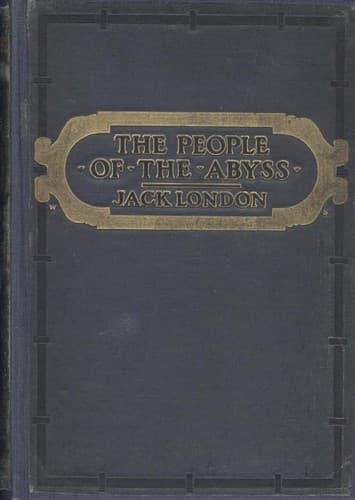
London (England) -- Social conditions; Poor -- England -- London
But at the best, it is a dull, animal happiness, the content of the
full belly. The dominant note of their lives is materialistic. They are
stupid and heavy, without imagination. The Abyss seems to exude a
stupefying atmosphere of torpor, which wraps about them and deadens
them. Religion passes them by. The Unseen holds for them neither terror
nor delight. They are unaware of the Unseen; and the full belly and the
evening pipe, with their regular “arf an’ arf,” is all they demand, or
dream of demanding, from existence.
This would not be so bad if it were all; but it is not all. The
satisfied torpor in which they are sunk is the deadly inertia that
precedes dissolution. There is no progress, and with them not to
progress is to fall back and into the Abyss. In their own lives they
may only start to fall, leaving the fall to be completed by their
children and their children’s children. Man always gets less than he
demands from life; and so little do they demand, that the less than
little they get cannot save them.
At the best, city life is an unnatural life for the human; but the city
life of London is so utterly unnatural that the average workman or
workwoman cannot stand it. Mind and body are sapped by the undermining
influences ceaselessly at work. Moral and physical stamina are broken,
and the good workman, fresh from the soil, becomes in the first city
generation a poor workman; and by the second city generation, devoid of
push and go and initiative, and actually unable physically to perform
the labour his father did, he is well on the way to the shambles at the
bottom of the Abyss.
If nothing else, the air he breathes, and from which he never escapes,
is sufficient to weaken him mentally and physically, so that he becomes
unable to compete with the fresh virile life from the country hastening
on to London Town to destroy and be destroyed.
Leaving out the disease germs that fill the air of the East End,
consider but the one item of smoke. Sir William Thiselton-Dyer, curator
of Kew Gardens, has been studying smoke deposits on vegetation, and,
according to his calculations, no less than six tons of solid matter,
consisting of soot and tarry hydrocarbons, are deposited every week on
every quarter of a square mile in and about London. This is equivalent
to twenty-four tons per week to the square mile, or 1248 tons per year
to the square mile. From the cornice below the dome of St. Paul’s
Cathedral was recently taken a solid deposit of crystallised sulphate
of lime. This deposit had been formed by the action of the sulphuric
acid in the atmosphere upon the carbonate of lime in the stone. And
this sulphuric acid in the atmosphere is constantly being breathed by
the London workmen through all the days and nights of their lives.
Public-domain text, read in full here on John Shaqi.
Reviews
Reviews
No reviews yet
Be the first to share your thoughts on this work.
Join the Discussion
Join the discussion
Sign in to leave a comment or review.
Sign InorCreate an account