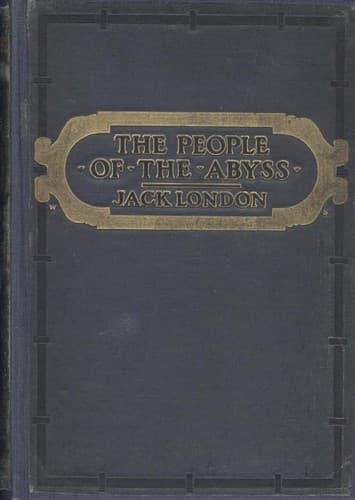
London (England) -- Social conditions; Poor -- England -- London
“But ’ere, give me your ’and,” he said, ripping open his ragged shirt.
“I’m fit for the anatomist, that’s all. I’m wastin’ away, sir, actually
wastin’ away for want of food. Feel my ribs an’ you’ll see.”
I put my hand under his shirt and felt. The skin was stretched like
parchment over the bones, and the sensation produced was for all the
world like running one’s hand over a washboard.
“Seven years o’ bliss I ’ad,” he said. “A good missus and three bonnie
lassies. But they all died. Scarlet fever took the girls inside a
fortnight.”
“After this, sir,” said the Carter, indicating the spread, and desiring
to turn the conversation into more cheerful channels; “after this, I
wouldn’t be able to eat a workhouse breakfast in the morning.”
“Nor I,” agreed the Carpenter, and they fell to discussing belly
delights and the fine dishes their respective wives had cooked in the
old days.
“I’ve gone three days and never broke my fast,” said the Carter.
“And I, five,” his companion added, turning gloomy with the memory of
it. “Five days once, with nothing on my stomach but a bit of orange
peel, an’ outraged nature wouldn’t stand it, sir, an’ I near died.
Sometimes, walkin’ the streets at night, I’ve ben that desperate I’ve
made up my mind to win the horse or lose the saddle. You know what I
mean, sir—to commit some big robbery. But when mornin’ come, there was
I, too weak from ’unger an’ cold to ’arm a mouse.”
As their poor vitals warmed to the food, they began to expand and wax
boastful, and to talk politics. I can only say that they talked
politics as well as the average middle-class man, and a great deal
better than some of the middle-class men I have heard. What surprised
me was the hold they had on the world, its geography and peoples, and
on recent and contemporaneous history. As I say, they were not fools,
these two men. They were merely old, and their children had undutifully
failed to grow up and give them a place by the fire.
One last incident, as I bade them good-bye on the corner, happy with a
couple of shillings in their pockets and the certain prospect of a bed
for the night. Lighting a cigarette, I was about to throw away the
burning match when the Carter reached for it. I proffered him the box,
but he said, “Never mind, won’t waste it, sir.” And while he lighted
the cigarette I had given him, the Carpenter hurried with the filling
of his pipe in order to have a go at the same match.
“It’s wrong to waste,” said he.
“Yes,” I said, but I was thinking of the wash-board ribs over which I
had run my hand.
CHAPTER IX.
THE SPIKE
First of all, I must beg forgiveness of my body for the vileness
through which I have dragged it, and forgiveness of my stomach for the
vileness which I have thrust into it. I have been to the spike, and
slept in the spike, and eaten in the spike; also, I have run away from
the spike.
Public-domain text, read in full here on John Shaqi.
Reviews
Reviews
No reviews yet
Be the first to share your thoughts on this work.
Join the Discussion
Join the discussion
Sign in to leave a comment or review.
Sign InorCreate an account