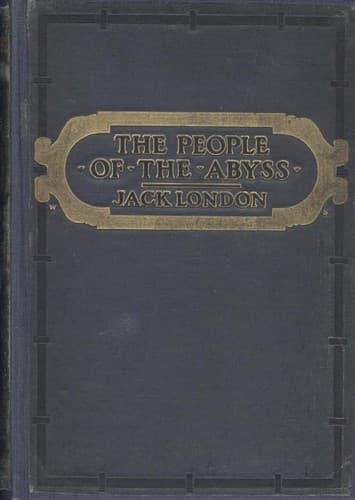
London (England) -- Social conditions; Poor -- England -- London
“Aw, I come ’ere for a rest,” he said complacently. “An’ another
night’s kip won’t ’urt me none.”
They were all of this opinion, so I was forced to “sling it” alone.
“You cawn’t ever come back ’ere again for a doss,” they warned me.
“No fear,” said I, with an enthusiasm they could not comprehend; and,
dodging out the gate, I sped down the street.
Straight to my room I hurried, changed my clothes, and less than an
hour from my escape, in a Turkish bath, I was sweating out whatever
germs and other things had penetrated my epidermis, and wishing that I
could stand a temperature of three hundred and twenty rather than two
hundred and twenty.
CHAPTER X.
CARRYING THE BANNER
“To carry the banner” means to walk the streets all night; and I, with
the figurative emblem hoisted, went out to see what I could see. Men
and women walk the streets at night all over this great city, but I
selected the West End, making Leicester Square my base, and scouting
about from the Thames Embankment to Hyde Park.
The rain was falling heavily when the theatres let out, and the
brilliant throng which poured from the places of amusement was hard put
to find cabs. The streets were so many wild rivers of cabs, most of
which were engaged, however; and here I saw the desperate attempts of
ragged men and boys to get a shelter from the night by procuring cabs
for the cabless ladies and gentlemen. I use the word “desperate”
advisedly, for these wretched, homeless ones were gambling a soaking
against a bed; and most of them, I took notice, got the soaking and
missed the bed. Now, to go through a stormy night with wet clothes,
and, in addition, to be ill nourished and not to have tasted meat for a
week or a month, is about as severe a hardship as a man can undergo.
Well fed and well clad, I have travelled all day with the spirit
thermometer down to seventy-four degrees below zero—one hundred and six
degrees of frost[1]; and though I suffered, it was a mere nothing
compared with carrying the banner for a night, ill fed, ill clad, and
soaking wet.
[1] This in the Klondike.—J. L.
The streets grew very quiet and lonely after the theatre crowd had gone
home. Only were to be seen the ubiquitous policemen, flashing their
dark lanterns into doorways and alleys, and men and women and boys
taking shelter in the lee of buildings from the wind and rain.
Piccadilly, however, was not quite so deserted. Its pavements were
brightened by well-dressed women without escort, and there was more
life and action there than elsewhere, due to the process of finding
escort. But by three o’clock the last of them had vanished, and it was
then indeed lonely.
At half-past one the steady downpour ceased, and only showers fell
thereafter. The homeless folk came away from the protection of the
buildings, and slouched up and down and everywhere, in order to rush up
the circulation and keep warm.
Public-domain text, read in full here on John Shaqi.
Reviews
Reviews
No reviews yet
Be the first to share your thoughts on this work.
Join the Discussion
Join the discussion
Sign in to leave a comment or review.
Sign InorCreate an account