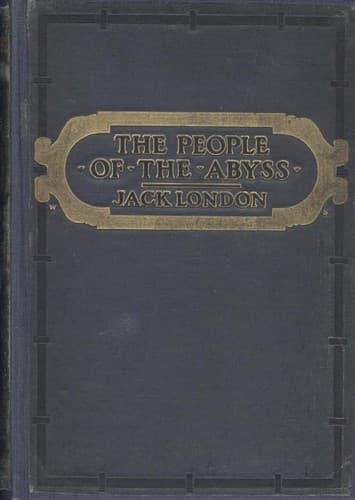
London (England) -- Social conditions; Poor -- England -- London
So far has the divorcement of the worker from the soil proceeded, that
the farming districts, the civilised world over, are dependent upon the
cities for the gathering of the harvests. Then it is, when the land is
spilling its ripe wealth to waste, that the street folk, who have been
driven away from the soil, are called back to it again. But in England
they return, not as prodigals, but as outcasts still, as vagrants and
pariahs, to be doubted and flouted by their country brethren, to sleep
in jails and casual wards, or under the hedges, and to live the Lord
knows how.
It is estimated that Kent alone requires eighty thousand of the street
people to pick her hops. And out they come, obedient to the call, which
is the call of their bellies and of the lingering dregs of
adventure-lust still in them. Slum, stews, and ghetto pour them forth,
and the festering contents of slum, stews, and ghetto are undiminished.
Yet they overrun the country like an army of ghouls, and the country
does not want them. They are out of place. As they drag their squat,
misshapen bodies along the highways and byways, they resemble some vile
spawn from underground. Their very presence, the fact of their
existence, is an outrage to the fresh, bright sun and the green and
growing things. The clean, upstanding trees cry shame upon them and
their withered crookedness, and their rottenness is a slimy desecration
of the sweetness and purity of nature.
Is the picture overdrawn? It all depends. For one who sees and thinks
life in terms of shares and coupons, it is certainly overdrawn. But for
one who sees and thinks life in terms of manhood and womanhood, it
cannot be overdrawn. Such hordes of beastly wretchedness and
inarticulate misery are no compensation for a millionaire brewer who
lives in a West End palace, sates himself with the sensuous delights of
London’s golden theatres, hobnobs with lordlings and princelings, and
is knighted by the king. Wins his spurs—God forbid! In old time the
great blonde beasts rode in the battle’s van and won their spurs by
cleaving men from pate to chine. And, after all, it is finer to kill a
strong man with a clean-slicing blow of singing steel than to make a
beast of him, and of his seed through the generations, by the artful
and spidery manipulation of industry and politics.
But to return to the hops. Here the divorcement from the soil is as
apparent as in every other agricultural line in England. While the
manufacture of beer steadily increases, the growth of hops steadily
decreases. In 1835 the acreage under hops was 71,327. To-day it stands
at 48,024, a decrease of 3103 from the acreage of last year.
Public-domain text, read in full here on John Shaqi.
Reviews
Reviews
No reviews yet
Be the first to share your thoughts on this work.
Elsewhere in the archive
Join the Discussion
Join the discussion
Sign in to leave a comment or review.
Sign InorCreate an account