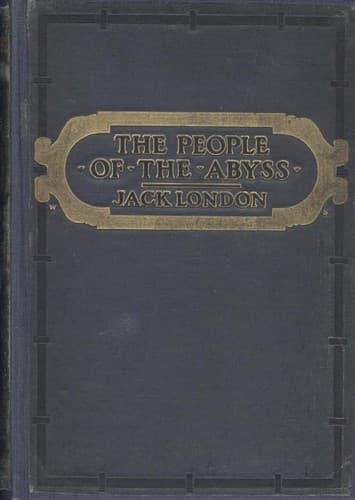
London (England) -- Social conditions; Poor -- England -- London
“No bad conduct, mind ye,” warned the bailiff, as he left us at work in
the midst of the women.
It was Saturday afternoon, and we knew quitting time would come early;
so we applied ourselves earnestly to the task, desiring to learn if we
could at least make our salt. It was simple work, woman’s work, in
fact, and not man’s. We sat on the edge of the bin, between the
standing hops, while a pole-puller supplied us with great fragrant
branches. In an hour’s time we became as expert as it is possible to
become. As soon as the fingers became accustomed automatically to
differentiate between hops and leaves and to strip half-a-dozen
blossoms at a time there was no more to learn.
We worked nimbly, and as fast as the women themselves, though their
bins filled more rapidly because of their swarming children, each of
which picked with two hands almost as fast as we picked.
“Don’tcher pick too clean, it’s against the rules,” one of the women
informed us; and we took the tip and were grateful.
As the afternoon wore along, we realised that living wages could not be
made—by men. Women could pick as much as men, and children could do
almost as well as women; so it was impossible for a man to compete with
a woman and half-a-dozen children. For it is the woman and the
half-dozen children who count as a unit, and by their combined capacity
determine the unit’s pay.
“I say, matey, I’m beastly hungry,” said I to Bert. We had not had any
dinner.
“Blimey, but I could eat the ’ops,” he replied.
Whereupon we both lamented our negligence in not rearing up a numerous
progeny to help us in this day of need. And in such fashion we whiled
away the time and talked for the edification of our neighbours. We
quite won the sympathy of the pole-puller, a young country yokel, who
now and again emptied a few picked blossoms into our bin, it being part
of his business to gather up the stray clusters torn off in the process
of pulling.
With him we discussed how much we could “sub,” and were informed that
while we were being paid a shilling for seven bushels, we could only
“sub,” or have advanced to us, a shilling for every twelve bushels.
Which is to say that the pay for five out of every twelve bushels was
withheld—a method of the grower to hold the hopper to his work whether
the crop runs good or bad, and especially if it runs bad.
Public-domain text, read in full here on John Shaqi.
Reviews
Reviews
No reviews yet
Be the first to share your thoughts on this work.
Elsewhere in the archive
Join the Discussion
Join the discussion
Sign in to leave a comment or review.
Sign InorCreate an account