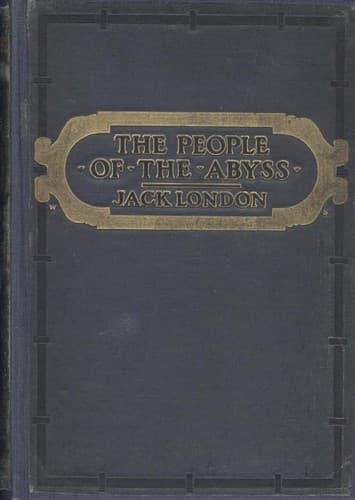
London (England) -- Social conditions; Poor -- England -- London
After all, it was pleasant sitting there in the bright sunshine, the
golden pollen showering from our hands, the pungent aromatic odour of
the hops biting our nostrils, and the while remembering dimly the
sounding cities whence these people came. Poor street people! Poor
gutter folk! Even they grow earth-hungry, and yearn vaguely for the
soil from which they have been driven, and for the free life in the
open, and the wind and rain and sun all undefiled by city smirches. As
the sea calls to the sailor, so calls the land to them; and, deep down
in their aborted and decaying carcasses, they are stirred strangely by
the peasant memories of their forbears who lived before cities were.
And in incomprehensible ways they are made glad by the earth smells and
sights and sounds which their blood has not forgotten though
unremembered by them.
“No more ’ops, matey,” Bert complained.
It was five o’clock, and the pole-pullers had knocked off, so that
everything could be cleaned up, there being no work on Sunday. For an
hour we were forced idly to wait the coming of the measurers, our feet
tingling with the frost which came on the heels of the setting sun. In
the adjoining bin, two women and half-a-dozen children had picked nine
bushels: so that the five bushels the measurers found in our bin
demonstrated that we had done equally well, for the half-dozen children
had ranged from nine to fourteen years of age.
Five bushels! We worked it out to eight-pence ha’penny, or seventeen
cents, for two men working three hours and a half. Fourpence farthing
apiece! a little over a penny an hour! But we were allowed only to
“sub” fivepence of the total sum, though the tally-keeper, short of
change, gave us sixpence. Entreaty was in vain. A hard-luck story could
not move him. He proclaimed loudly that we had received a penny more
than our due, and went his way.
Granting, for the sake of the argument, that we were what we
represented ourselves to be—namely, poor men and broke—then here was
our position: night was coming on; we had had no supper, much less
dinner; and we possessed sixpence between us. I was hungry enough to
eat three sixpenn’orths of food, and so was Bert. One thing was patent.
By doing 16.3 per cent. justice to our stomachs, we would expend the
sixpence, and our stomachs would still be gnawing under 83.3 per cent.
injustice. Being broke again, we could sleep under a hedge, which was
not so bad, though the cold would sap an undue portion of what we had
eaten. But the morrow was Sunday, on which we could do no work, though
our silly stomachs would not knock off on that account. Here, then, was
the problem: how to get three meals on Sunday, and two on Monday (for
we could not make another “sub” till Monday evening).
We knew that the casual wards were overcrowded; also, that if we begged
from farmer or villager, there was a large likelihood of our going to
jail for fourteen days. What was to be done? We looked at each other in
despair—
Public-domain text, read in full here on John Shaqi.
Reviews
Reviews
No reviews yet
Be the first to share your thoughts on this work.
Elsewhere in the archive
Join the Discussion
Join the discussion
Sign in to leave a comment or review.
Sign InorCreate an account