Clergy -- Fiction; England -- Social life and customs -- 19th century -- Fiction
Produced by Delphine Lettau and the Online Distributed
Proofreading Team at http://www.pgdp.net
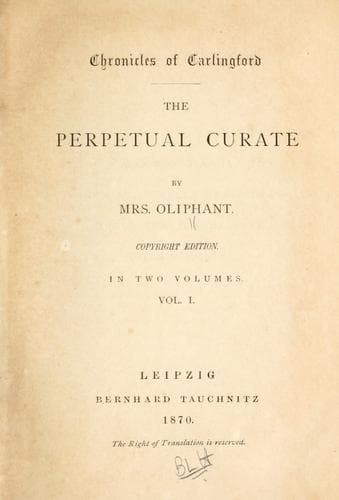
Chronicles of Carlingford.
THE
PERPETUAL CURATE
MRS OLIPHANT
_ALLA PADRONA MIA;
ED A TE, SORELLA CARISSIMA!
CONSOLATRICI GENTILLISSIME
DELLA DESOLATA._
CHAPTER I.
Carlingford is, as is well known, essentially a quiet place. There is
no trade in the town, properly so called. To be sure, there are two or
three small counting-houses at the other end of George Street, in that
ambitious pile called Gresham Chambers; but the owners of these places
of business live, as a general rule, in villas, either detached or
semi-detached, in the North-end, the new quarter, which, as everybody
knows, is a region totally unrepresented in society. In Carlingford
proper there is no trade, no manufactures, no anything in particular,
except very pleasant parties and a superior class of people--a very
superior class of people, indeed, to anything one expects to meet
with in a country town, which is not even a county town, nor the seat
of any particular interest. It is the boast of the place that it has no
particular interest--not even a public school: for no reason in the
world but because they like it, have so many nice people collected
together in those pretty houses in Grange Lane--which is, of course, a
very much higher tribute to the town than if any special inducement had
led them there. But in every community some centre of life is necessary.
This point, round which everything circles, is, in Carlingford, found in
the clergy. They are the administrators of the commonwealth, the only
people who have defined and compulsory duties to give a sharp outline to
life. Somehow this touch of necessity and business seems needful even
in the most refined society: a man who is obliged to be somewhere at a
certain hour, to do something at a certain time, and whose public duties
are not volunteer proceedings, but indispensable work, has a certain
position of command among a leisurely and unoccupied community, not to
say that it is a public boon to have some one whom everybody knows and
can talk of. The minister in Salem Chapel was everything in his little
world. That respectable connection would not have hung together half so
closely but for this perpetual subject of discussion, criticism, and
patronage; and, to compare great things with small, society in Carlingford
recognised in some degree the same human want. An enterprising or
non-enterprising rector made all the difference in the world in Grange
Lane; and in the absence of a rector that counted for anything (and poor
Mr Proctor was of no earthly use, as everybody knows), it followed, as a
natural consequence, that a great deal of the interest and influence of
the position fell into the hands of the Curate of St Roque's.
Public-domain text, read in full here on John Shaqi.
Reviews
Reviews
No reviews yet
Be the first to share your thoughts on this work.
Join the Discussion
Join the discussion
Sign in to leave a comment or review.
Sign InorCreate an account