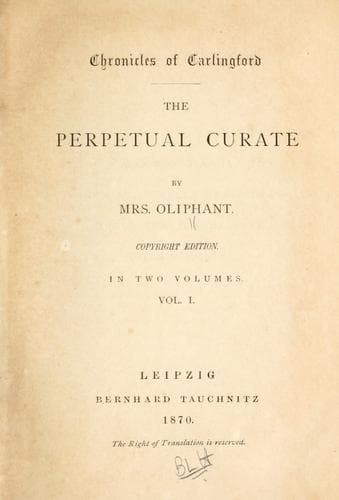
Clergy -- Fiction; England -- Social life and customs -- 19th century -- Fiction
Next week was Passion Week, and full of occupation. Even if it had been
consistent either with Mr Wentworth's principles or Lucy's to introduce
secular affairs into so holy a season, they had not time or opportunity,
as it happened, which was perhaps just as well; for otherwise the
premonitory thrill of expectation which had disturbed Lucy's calm, and
the bitter exasperation against himself and his fate with which Mr
Wentworth had discovered that he dared not say anything, might have
caused an estrangement between them. As it was, the air was thundery and
ominous through all the solemn days of the Holy Week. A consciousness as
of something about to happen overshadowed even the "district," and
attracted the keen observation of the lively spectators at Wharfside.
They were not greatly up in matters of doctrine, nor perhaps did they
quite understand the eloquent little sermon which the Perpetual Curate
gave them on Good Friday in the afternoon, between his own services, by
way of impressing upon their minds the awful memories of the day; but
they were as skilful in the variations of their young evangelist's
looks, and as well qualified to decide upon the fact that there was "a
something between" him and Miss Lucy Wodehouse, as any practised
observer in the higher ranks of society. Whether the two had "'ad an
unpleasantness," as, Wharfside was well aware, human creatures under
such circumstances are liable to have, the interested community could
not quite make out; but that something more than ordinary was going on,
and that the prettiest of all the "Provident ladies" had a certain
preoccupation in her blue eyes, was a fact perfectly apparent to
that intelligent society. And, indeed, one of the kinder matrons in
Prickett's Lane had even ventured so far as to wish Miss Lucy "a 'appy
weddin' when the time comes." "And there's to be a sight o' weddings
this Easter," had added another, who was somewhat scandalised by the
flowers in the bonnet of one of the brides-elect, and proceeded to say
so in some detail. "But Miss Lucy won't wear no bonnet; the quality goes
in veils: and there never was as full a church as there will be to see
it, wishing you your 'ealth and 'appiness, ma'am, as aint no more nor
you deserve, and you so good to us poor folks." All which felicitations
and inquiries had confused Lucy, though she made her way out of them
with a self-possession which amazed her sister.
"You see what everybody thinks, dear," said that gentle woman, when
they had made their escape.
Public-domain text, read in full here on John Shaqi.
Reviews
Reviews
No reviews yet
Be the first to share your thoughts on this work.
Join the Discussion
Join the discussion
Sign in to leave a comment or review.
Sign InorCreate an account