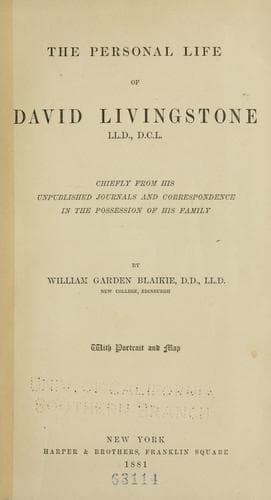
The Personal Life of David Livingstone: Chiefly from his Unpublished Journals and Correspondence in the Possession of His FamilyBlaikie, William Garden
Religion
The Personal Life of David Livingstone: Chiefly from his Unpublished Journals and Correspondence in the Possession of His Family
Blaikie, William Garden
Livingstone, David, 1813-1873
"It is a glorious river; you never saw anything so grand. The
banks are extremely beautiful, lined with gigantic trees,
many quite new. One bore a fruit a foot in length and three
inches in diameter. Another measured seventy feet in
circumference. Apart from the branches it looked like a mass
of granite; and then the Bakoba in their canoes--did I not
enjoy sailing in them? Remember how long I have been in a
parched-up land, and answer. The Bakoba are a fine frank race
of men, and seem to understand the message better than any
people to whom I have spoken on Divine subjects for the first
time. What think you of a navigable highway into a large
section of the interior? yet that the Tamanak'le is.... Who
will go into that goodly land? Who? Is it not the Niger of
this part of Africa?... I greatly enjoyed sailing in their
canoes, rude enough things, hollowed out of the trunks of
single trees, and visiting the villages along the Zouga. I
felt but little when I looked on the lake; but the Zouga and
Tamanak'le awakened emotions not to be described. I hope to
go up the latter next year."
The discovery of the lake and the river was communicated to the Royal
Geographical Society in extracts from Livingstone's letters to the
London Missionary Society, and to his friend and former fellow-traveler,
Captain Steele. In 1849 the Society voted him a sum of twenty-five
guineas "for his successful journey, in company with Messrs. Oswell and
Murray, across the South African desert, for the discovery of an
interesting country, a fine river, and an extensive inland lake." In
addressing Dr. Tidman and Alderman Challis, who represented the London
Missionary Society, the President (the late Captain, afterward
Rear-Admiral, W. Smyth, R.N., who distinguished himself in early life by
his journey across the Andes to Lima, and thence to the Atlantic)
adverted to the value of the discoveries in themselves, and in the
influence they would have on the regions beyond. He spoke also of the
help which Livingstone had derived as an explorer from his influence as
a missionary. The journey he had performed successfully had hitherto
baffled the best-furnished travelers. In 1834, an expedition under Dr.
Andrew Smith, the largest and best-appointed that ever left Cape Town,
had gone as far as 23° south latitude; but that proved to be the utmost
distance they could reach, and they were compelled to return. Captain
Sir James E. Alexander, the only scientific traveler subsequently sent
out from England by the Geographical Society, in despair of the lake,
and of discovery by the oft-tried eastern route, explored the
neighborhood of the western coast instead[30]. The President frankly
ascribed Livingstone's success to the influence he had acquired as a
missionary among the natives, and Livingstone thoroughly believed this.
"The lake," he wrote to his friend Watt, "belongs to missionary
Public-domain text, read in full here on John Shaqi.
Reviews
Reviews
No reviews yet
Be the first to share your thoughts on this work.
Elsewhere in the archive
Join the Discussion
Join the discussion
Sign in to leave a comment or review.
Sign InorCreate an account