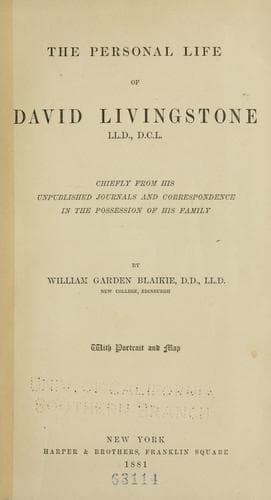
The Personal Life of David Livingstone: Chiefly from his Unpublished Journals and Correspondence in the Possession of His FamilyBlaikie, William Garden
Religion
The Personal Life of David Livingstone: Chiefly from his Unpublished Journals and Correspondence in the Possession of His Family
Blaikie, William Garden
Livingstone, David, 1813-1873
enterprise." "Only last year," he subsequently wrote to the Geographical
Society, "a party of engineers, in about thirty wagons, made many and
persevering efforts to cross the desert at different points, but though
inured to the climate, and stimulated by the prospect of gain from the
ivory they expected to procure, they were compelled, for want of water,
to give up the undertaking." The year after Livingstone's first visit,
Mr. Francis Galton tried, but failed, to reach the lake, though he was
so successful in other directions as to obtain the Society's gold
medal in 1852.
[Footnote 30: Journal of the Royal Geographical Society, vol. xx. p.
xxviii.]
Livingstone was evidently gratified at the honor paid him, and the
reception of the twenty-five guineas from the Queen. But the gift had
also a comical side. It carried him back to the days of his Radical
youth, when he and his friends used to criticise pretty sharply the
destination of the nation's money. "The Royal Geographical Society," he
writes to his parents (4th December, 1850), "have awarded twenty-five
guineas for the discovery of the lake. It is from the Queen. You must
be very loyal, all of you. Next time she comes your way, shout till you
are hoarse. Oh, you Radicals, don't be thinking it came out of your
pockets! Long live Victoria[31]!"
[Footnote 31: In a more serious vein he wrote in a previous letter: "I
wonder you do not go to see the Queen. I was as disloyal as others when
in England, for though I might have seen her in London, I never went. Do
you ever pray for her?" This letter is dated 5th February, 1850, and
must have been written before he heard of the prize.]
Defeated in his endeavor to reach Sebituane in 1849, Livingstone, the
following season, put in practice his favorite maxim, "Try again." He
left Kolobeng in April, 1850, and this time he was accompanied by
Sechéle, Mebalwe, twenty Bakwains, Mrs. Livingstone, and their whole
troop of infantry, which now amounted to three. Traveling in the
charming climate of South Africa in the roomy wagon, at the pace of two
miles and a half an hour, is not like traveling at home; but it was a
proof of Livingstone's great unwillingness to be separated from his
family, that he took them with him, notwithstanding the risk of
mosquitoes, fever, and want of water. The people of Kolobeng were so
engrossed at the time with their employments, that till harvest was
over, little missionary work could be done.
Public-domain text, read in full here on John Shaqi.
Reviews
Reviews
No reviews yet
Be the first to share your thoughts on this work.
Elsewhere in the archive
Join the Discussion
Join the discussion
Sign in to leave a comment or review.
Sign InorCreate an account