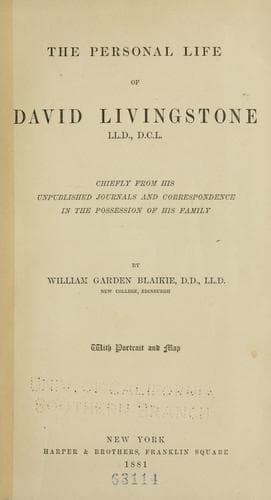
The Personal Life of David Livingstone: Chiefly from his Unpublished Journals and Correspondence in the Possession of His FamilyBlaikie, William Garden
Religion
The Personal Life of David Livingstone: Chiefly from his Unpublished Journals and Correspondence in the Possession of His Family
Blaikie, William Garden
Livingstone, David, 1813-1873
In Dean Stanley's _Sinai and Palestine_ allusion is made to a kindred
experience,--that which bore Abraham from Chaldea, Moses from Egypt, and
the greater part of the tribes from the comfortable pastures of Gilead
and Bashan to the rugged hill-country of Judah and Ephraim.
Notwithstanding all the attractions of the richer countries, they were
borne onward and forward, not knowing whither they went; instinctively
feeling that they were fulfilling the high purposes to which they were
called. In the later part of Livingstone's life, the necessity of going
forward to the close of the career that had opened for him seemed to
settle the whole question of duty.
But at this earlier stage, he had been conscientiously scrutinizing all
that had any bearing on that question; and now that he finds himself
close to his home, and can thank God for the safe confinement of his
wife, and the health of the new-born child, he gathers together all the
providences that showed that in this journey, which excited such horror
even among his best friends, he had after all been following the
guidance of his Father. First, in the matter of guides, he had been
wonderfully helped, notwithstanding a deep plot to deprive him of any.
Then there was the sickness of Sekómi, whose interest had been secured
through his going to see him, and prescribing for him; this had
propitiated one of the tribes. The services of Shobo, too, and the
selection of the northern route, proposed by Kamati, had been of great
use. Their going to Seshéke, and their detention for two months, thus
allowing them time to collect information respecting the whole country;
the river Chobe not rising at its usual time; the saving of
Livingstone's oxen from the tsetse, notwithstanding their detention on
the Zouga; his not going with Mr. Oswell to a place where the tsetse
destroyed many of the oxen; the better health of Mrs. Livingstone during
her confinement than in any previous one; a very opportune present they
had got, just before her confinement, of two bottles of wine[33]; the
approbation of the Directors, the presentation of a gold watch by
Captain Steele, the kind attentions of Mr. Oswell, and the cookery of
one of their native servants named George; the recovery of Thomas,
whereas at Kuruman a child had been cut off; the commencement of the
rains, just as they were leaving the river, and the request of Mr.
Oswell that they should draw upon him for as much money as they should
need, were all among the indications that a faithful and protecting
Father in heaven had been ordering their path, and would order it in
like manner in all time to come.
[Footnote 33: In writing to his father, Livingstone mentions that the
wine was a gift from Mrs. Bysshe Shelley, in acknowledgment of his aid
in repairing a wheel of her wagon.]
Public-domain text, read in full here on John Shaqi.
Reviews
Reviews
No reviews yet
Be the first to share your thoughts on this work.
Elsewhere in the archive
Join the Discussion
Join the discussion
Sign in to leave a comment or review.
Sign InorCreate an account