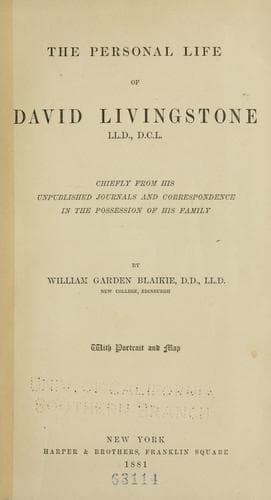
The Personal Life of David Livingstone: Chiefly from his Unpublished Journals and Correspondence in the Possession of His FamilyBlaikie, William Garden
Religion
The Personal Life of David Livingstone: Chiefly from his Unpublished Journals and Correspondence in the Possession of His Family
Blaikie, William Garden
Livingstone, David, 1813-1873
Writing at this time to his father-in-law, Mr. Moffat, he said, after
announcing the birth of Oswell: "What you say about difference of
opinion is true. In my past life, I have always managed to think for
myself, and act accordingly. I have occasionally met with people who
took it on themselves to act for me, and they have offered their
thoughts with an emphatic 'I think'; but I have excused them on the
score of being a little soft-headed in believing they could think both
for me and themselves."
While Kolobeng was Livingstone's headquarters, a new trouble rose upon
the mission horizon. The Makololo (as Sebituane's people were called)
began to practice the slave-trade. It arose simply from their desire to
possess guns. For eight old muskets they had given to a neighboring
tribe eight boys, that had been taken from their enemies in war, being
the only article for which the guns could be got. Soon after, in a fray
against another tribe, two hundred captives were taken, and, on
returning, the Makololo met some Arab traders from Zanzibar, who for
three muskets received about thirty of their captives.
Another of the master ideas of his life now began to take hold upon
Livingstone. Africa was exposed to a terrible evil through the desire of
the natives to possess articles of European manufacture, and their
readiness for this purpose to engage in the slave-trade. Though no
African had ever been known to sell his own children into captivity, the
tribes were ready enough to sell other children that had fallen into
their hands by war or otherwise. But if a legitimate traffic were
established through which they might obtain whatever European goods they
desired in exchange for ivory and other articles of native produce,
would not this frightful slave-trade be brought to an end? The idea was
destined to receive many a confirmation before Livingstone drew his last
breath of African air. It naturally gave a great impulse to the purpose
which had already struck its roots into his soul--to find a road to the
sea either on the eastern or western coast. Interests wider and grander
than even the planting of mission stations on the territories of
Sebituane now rose to his view. The welfare of the whole continent, both
spiritual and temporal, was concerned in the success of this plan of
opening new channels to the enterprise of British and other merchants,
always eager to hear of new markets for their goods. By driving away the
slave-trade, much would be done to prepare the way for Christian
missions which could not thrive in an atmosphere of war and commotion.
An idea involving issues so vast was fitted to take a right powerful
hold on Livingstone's heart, and make him feel that no sacrifice could
be too great to be encountered, cheerfully and patiently, for such
an end.
Writing to the Directors (October, 1851), he says:
Public-domain text, read in full here on John Shaqi.
The Personal Life of David Livingstone: Chiefly from his Unpublished Journals and Correspondence in the Possession of His Family — John Shaqi
Reviews
Reviews
No reviews yet
Be the first to share your thoughts on this work.
Elsewhere in the archive
Join the Discussion
Join the discussion
Sign in to leave a comment or review.
Sign InorCreate an account